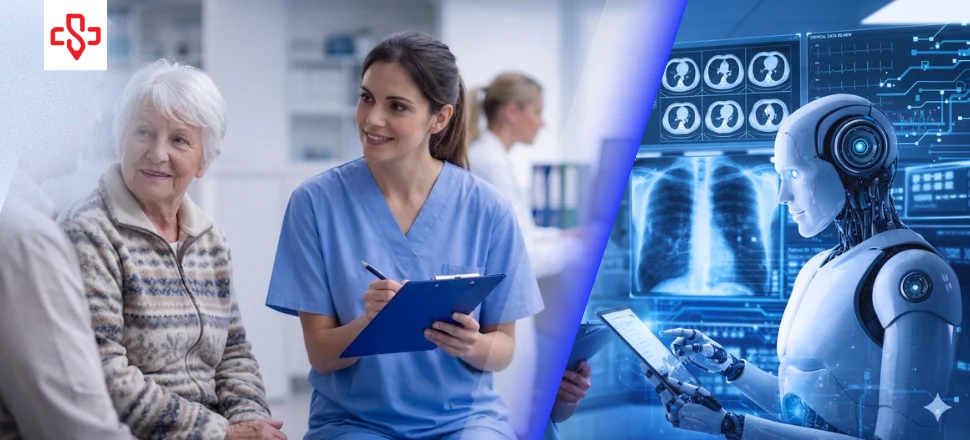

Step into any emergency department on a busy evening. Alarms beep, stretchers roll, phones ring, and physicians move fast—juggling trauma cases, complex diagnoses, and split-second decisions. Amid this controlled chaos, however, there’s someone quietly ensuring that every detail, every vital sign, and every provider order is accurately captured: the live scribes for emergency departments.
While patients may never know their name, ER medical scribes play a vital role in keeping the department running smoothly. In fact, they bridge rapid clinical care and detailed documentation. As a result, they become the ER’s unsung heroes—invisible yet indispensable.
Why Documentation Defines the Emergency Department
Emergency medicine runs on speed and precision. Therefore, every procedure, order, and interaction must be recorded in the EMR for patient safety, compliance, and reimbursement.
However, EMR systems often slow providers down. Studies show emergency physicians spend nearly 44% of their time documenting—leaving less than one-third of their shift for direct patient care. Consequently, this leads to fatigue, bottlenecks, and frustration.
This is exactly where live scribes for emergency departments step in. Working side by side with providers, they capture every encounter in real time. As a result, doctors can focus on clinical decision-making instead of data entry.
The Role of a Live ER Scribe
A live scribe for emergency departments is more than a fast typist. Rather, they are trained clinical observers fluent in medical terminology, hospital workflows, and high-pressure environments.
- Real-Time Documentation
First and foremost, every detail—patient history, physical exam, diagnostic results, and provider impressions—is entered into the EMR as it happens. Therefore, charts are complete and ready for sign-off by the end of each encounter. - Adaptability Under Pressure
Moreover, live scribes provide context-aware documentation that technology alone cannot match. When cases change course—as they often do in the ER—the scribe adapts instantly. Learn more about live medical scribes vs AI transcription. - Clinical Team Integration
In addition, scribes become part of the ER workflow. They anticipate needs, clarify orders quickly, and maintain documentation continuity during rapid patient transitions.
Ultimately, while the work may not be glamorous, it is absolutely essential to care delivery.
Speed and Accuracy: The ER Balancing Act
In emergency medicine, every second counts. On one hand, speed is critical. On the other hand, accuracy cannot be compromised. Rushed documentation can lead to revenue loss, compliance risks, and patient safety concerns.
Fortunately, live scribes for emergency departments bring balance and structure to this challenge:
- Faster Throughput: Physicians can move efficiently between patients.
- Complete Charts: Documentation remains detailed and compliant.
- Reduced Errors: Real-time entry minimizes omissions and inaccuracies.
“When I have a scribe, I can focus on medicine, not mouse clicks—and that changes everything.” — Emergency Physician
Live Scribes vs. No Scribes: A Quick Comparison
| Factor | Without Scribes | With Live ER Scribes |
|---|---|---|
| Physician Time Allocation | High documentation burden | More patient-focused care |
| Chart Completion | Delayed or after shift | Completed in real time |
| Error Risk | Higher due to fatigue | Reduced with real-time accuracy |
| Provider Burnout | High | Significantly reduced |
| Patient Interaction | Screen-focused | More face-to-face engagement |
The Invisible ROI of Live Scribes in the ER
At first glance, scribes may seem like an added expense. However, their return on investment is substantial.
- Productivity Gains: Providers can see more patients per shift.
- Revenue Protection: Accurate documentation supports proper coding and billing.
- Compliance Confidence: Detailed records reduce audit risks.
- Provider Retention: Lower burnout leads to reduced turnover.
Therefore, in a high-pressure environment with tight margins, live scribes for emergency departments play a critical role in maintaining both efficiency and financial stability.
Why Live Scribes Outperform Technology in the ER
Although AI transcription tools continue to evolve, they still fall short in dynamic clinical environments. In contrast, human scribes offer unmatched adaptability.
- Context Awareness: They understand clinical nuance and intent.
- Immediate Clarification: They verify information directly with providers.
- Environmental Adaptation: They handle noise, interruptions, and multitasking seamlessly.
In short, an emergency department scribe does more than document—they interpret and support care in real time.
Reducing Provider Burnout in the Emergency Department
Emergency medicine has one of the highest e burnout rates. Because of this, reducing administrative burden is essential.
Live scribes for emergency departments help by:
- Managing documentation during shifts.
- Ensuring charts are completed on time.
- Allowing physicians to focus on patient care.
As a result, providers experience less stress, fewer errors occur, and overall care quality improves.
The Patient’s Perspective: More Attention, Better Outcomes
Although patients rarely interact with scribes directly, they benefit significantly. For example, when physicians maintain eye contact instead of focusing on screens, trust improves.
- Higher patient satisfaction scores (HCAHPS).
- Clearer communication.
- Better adherence to treatment plans.
Ultimately, this leads to better outcomes and a more positive care experience.
A Day in the Life of an ER Scribe
Throughout a shift, scribes work in sync with providers. For instance, they may:
- Document trauma assessments.
- Capture procedure notes.
- Record lab results and medications.
- Prepare discharge summaries.
Meanwhile, between cases, they review documentation, confirm details, and prepare for the next patient. By the end of the shift, charts are complete—something many providers rarely achieve alone.
Live Scribes for Emergency Departments in a Nutshell
Emergency departments continue to rely on live medical scribes to streamline workflows and support clinical teams.
In conclusion, they are the backbone of accurate documentation, provider well-being, and operational efficiency. Even in a digital-first world, the ER proves that human support remains essential.
Partner with Proven ER Scribing Experts
Scribe.ology delivers real-time, on-site documentation excellence for emergency departments. Whether you operate a large hospital system or a regional facility, our live scribes for emergency departments help providers stay focused on patient care.
Ready to improve efficiency and reduce burnout? Contact Scribe.ology today for tailored ER scribe solutions.