
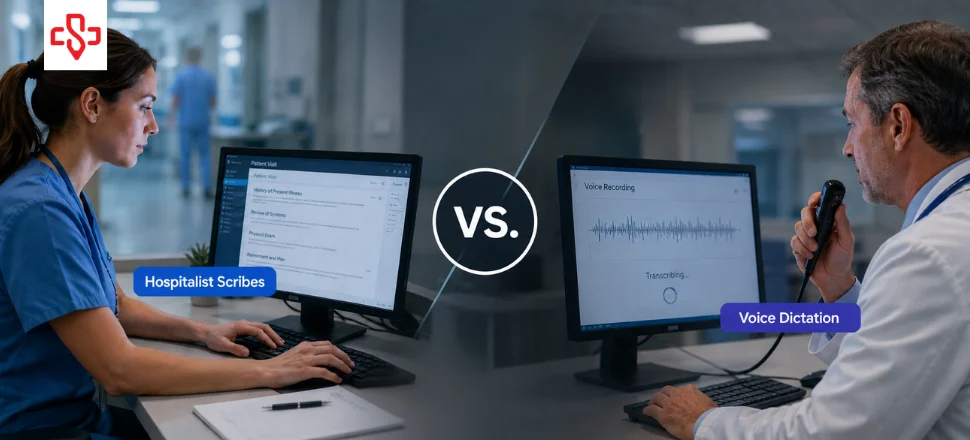
For hospitalists juggling twelve to eighteen patients a shift, documentation eats up the workday. When comparing hospitalist scribes vs. voice dictation, one question matters most. Which method actually gives physicians their time back?
Both tools promise faster charting. However, the real time savings show up differently once you follow a hospitalist through a full shift.
The Real Time Cost of Documentation for Hospitalists
Hospitalists spend a large share of their shift on notes and EHR navigation. This happens instead of direct patient care. For instance, rounding and discharge summaries generate documentation in real time, often between rooms.
In most cases, the bottleneck isn’t typing speed. Instead, it’s the constant switching between clinical thinking and clerical entry. As a result, tools that reduce this switching tend to save more time.
This is partly why hospital medicine scribes are evaluated on cognitive load. Removing mental burden matters more than typing speed alone.
How Voice Dictation Works (and Where It Falls Short)
Voice dictation software converts spoken words into text in real time. It’s often paired with AI tools that summarize an encounter. Because of this, it’s fast to deploy and needs no extra staffing.
However, dictation still requires the physician to speak the note. This means structuring findings and dictating the plan aloud. Even with AI help, physicians still edit drafts before signing.
For example, complex admissions with several comorbidities take longer. Editing time can rival the time it takes to type manually. Many groups pairing dictation with EHR integration support still report this editing burden.
Why Hospitalist Scribes Save More Time
This is where hospitalist scribes make the bigger difference. A trained scribe documents the encounter live, on-site or virtually. They follow the physician into the room or listen through a HIPAA-compliant audio link.
The scribe builds the note directly in the EHR. They pull forward relevant history and flag pending labs as they go. Crucially, the physician isn’t producing the first draft at all.
Instead, the physician simply reviews and signs a note that’s already near-final. Therefore, documentation shifts from an active task to a quick review step. That shift is where most of the real time savings come from.
Additionally, scribes trained in inpatient workflows understand rounding order. This reduces the back-and-forth that can slow down virtual medical scribes unfamiliar with hospital medicine.
Hospitalist Scribes vs. Voice Dictation: Time Comparison
| Factor | Voice Dictation / Ambient AI | Hospitalist Scribe |
|---|---|---|
| Note drafted by | Physician (spoken), AI-assisted | Scribe, in real time |
| Physician review/edit time per note | 3–7 minutes | 30–90 seconds |
| Time added per encounter | Low setup, higher editing | Near-zero editing, higher setup |
| Best suited for | Solo practitioners, low patient volume | High-volume rounding, complex admissions |
| Typical daily time saved | 30–60 minutes | 60–120 minutes |
The gap widens with patient complexity. A quick follow-up note dictates fine either way. But for a multi-problem admission, scribes clearly pull ahead.
Accuracy, EHR Integration, and Downstream Time Costs
Time saved at the bedside doesn’t always hold up later. Dictation errors, like misheard medication names, can require correction after the fact.
By contrast, scribes flag uncertainty in real time. This means fewer errors ever reach the chart. Consequently, this matters for billing accuracy too.
A 2023 analysis in the Journal of Hospital Medicine looked at this closely. It found that documentation quality directly affects coding accuracy and physician workload.[PubMed] In other words, time saved upfront only counts if it doesn’t create errors later. Groups often pair scribe programs with structured scribe onboarding to keep quality high.
Why Hospitalist Scribes Are the Stronger Choice
Voice dictation can work for lower patient volumes. It suits routine cases or physicians who want full control over phrasing.
But for most hospitalist teams, scribes deliver the bigger win. They handle high-volume rounding and complex comorbidity documentation with ease. They also support teaching hospitalists managing residents during rounds.
Teams weighing this often start by reviewing their revenue cycle documentation patterns. This shows exactly where charting delays cost the most time.
Ultimately, the time hospitalists get back isn’t just about typing speed. It’s about how much cognitive work gets removed entirely. Scribe.ology’s inpatient-trained scribes are built for this exact workflow. Onboarding is matched to your EHR and templates from day one.