
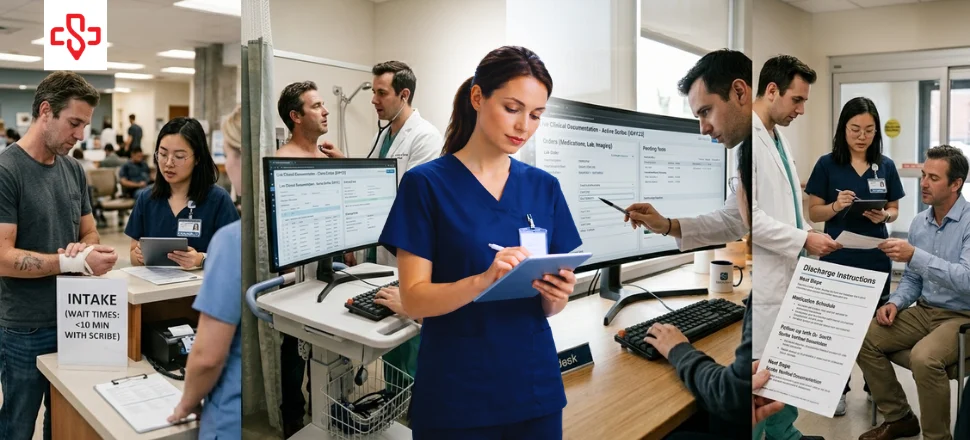
Hospitals operate in fast-paced, high-pressure environments where efficiency, accuracy, and timely decision-making are critical. From the moment a patient arrives at intake to the point of discharge, teams must carefully coordinate every step in the workflow. However, increasing documentation requirements in electronic health records (EHRs) often slow down processes and place a heavy administrative burden on physicians. As a result, medical scribes in hospital workflow play a vital role.
By handling real-time documentation and actively supporting clinical teams, hospital medical scribes streamline operations, improve communication, and enhance patient care across the entire hospital journey.
The Complexity of Hospital Workflows
Hospital workflows involve multiple departments, including triage, diagnostics, treatment, and discharge planning. Therefore, each stage requires accurate documentation to ensure continuity of care and compliance with healthcare regulations.
Physicians document patient histories, clinical findings, diagnostic results, treatment decisions, and discharge instructions. According to a study published in the Annals of Internal Medicine, physicians spend nearly two hours on EHR tasks for every hour of direct patient care. Consequently, this imbalance reduces efficiency and delays critical processes in hospital settings.
As patient volumes continue to rise, hospitals must find ways to maintain efficiency without compromising care quality.
How Medical Scribes Support the Intake Process
The patient journey begins at intake, where staff collect initial information, including medical history, symptoms, and vital signs. Accurate documentation at this stage guides clinical decisions throughout the visit.
Medical scribes capture patient information in real time, ensuring that teams record all relevant details in the EHR. As a result, clinicians avoid repeated data entry and quickly access complete patient records.
In addition, documentation consistency becomes even more critical during system transitions. This is especially true during EHR updates or migrations.
Optimizing Documentation During Diagnosis and Treatment
Once the intake process is complete, physicians move on to diagnosis and treatment. At this stage, they review test results, consult with specialists, and make clinical decisions.
Medical scribes document these interactions in real time, ensuring that they capture every detail accurately. Therefore, physicians can focus fully on patient care without interruptions from data entry tasks.
Additionally, accurate documentation supports billing, coding, and compliance requirements. Hospitals that prioritize documentation quality often implement performance tracking systems. To better understand how teams measure quality, explore this guide on scribe quality metrics.
Enhancing Workflow Efficiency Across Departments
Hospital care involves collaboration between multiple departments, including radiology, laboratory services, and specialty units. Therefore, clear communication and accurate documentation ensure that patient information flows smoothly between teams.
Medical scribes maintain detailed and organized records that all providers involved in patient care can easily access. As a result, teams reduce delays caused by incomplete or unclear documentation.
Moreover, scribes adapt to different clinical schedules and environments. Their flexibility supports various hospital operations, including day, night, and rotating shifts. Learn how scribes integrate into hospital schedules in this overview of scribe work shifts.
Reducing Delays in Discharge Planning
The discharge process represents a critical step in the hospital workflow. It involves summarizing patient care, providing instructions, and coordinating follow-up appointments. However, delays in documentation can slow down discharge and reduce bed availability for incoming patients.
Medical scribes ensure that teams document discharge summaries, prescriptions, and care instructions accurately and promptly. Consequently, patients leave the hospital sooner while still receiving clear guidance for post-treatment care.
By improving documentation speed and accuracy, scribes reduce bottlenecks and improve overall patient flow.
Hospital Workflow with Medical Scribes
| Workflow Stage | How Medical Scribes Optimize Each Step |
|---|---|
| Patient Intake | Captures patient history and symptoms in real time |
| Initial Assessment | Documents physician observations and exam findings |
| Diagnostics | Records lab results and imaging interpretations accurately |
| Treatment Planning | Updates care plans, medications, and physician notes |
| Care Coordination | Ensures clear documentation across departments |
| Discharge Process | Prepares discharge summaries and follow-up instructions promptly |
Impact on Physician Productivity and Burnout
Physician burnout continues to rise in hospital environments. Administrative workload, long hours, and documentation demands significantly increase stress and fatigue.
Research from the American Medical Association indicates that nearly 50% of physicians experience burnout, with documentation burden acting as a major contributing factor. By handling charting tasks, medical scribes reduce this burden and allow physicians to focus on clinical responsibilities.
As a result, providers manage their time more effectively, improve work-life balance, and maintain higher levels of job satisfaction.
Improving Patient Experience
Efficient workflows benefit both healthcare providers and patients. When scribes handle documentation, physicians engage more directly with patients, which leads to better communication and stronger relationships.
Additionally, faster workflows reduce waiting times and ensure smoother transitions between different stages of care. As a result, patients receive timely diagnosis, treatment, and discharge.
The Future of Hospital Workflow Optimization
As hospitals adopt advanced technologies and expand services, the need for efficient workflows will continue to grow. Medical scribes are becoming an integral part of healthcare systems by supporting documentation, improving accuracy, and enhancing operational efficiency.
Therefore, hospitals aiming to improve performance and patient outcomes are increasingly investing in professional scribing services.
From intake to discharge, every step in the hospital workflow depends on accurate documentation and efficient processes. However, increasing administrative demands can slow down operations and contribute to physician burnout.
By integrating medical scribes in hospital workflow, hospitals streamline documentation, improve communication, and enhance patient care. Ultimately, scribes enable healthcare providers to focus on what matters most—delivering high-quality treatment while maintaining efficiency across all stages of care.
As healthcare systems evolve, the role of medical scribes will continue to expand, helping hospitals meet growing patient demands while maintaining operational excellence.