
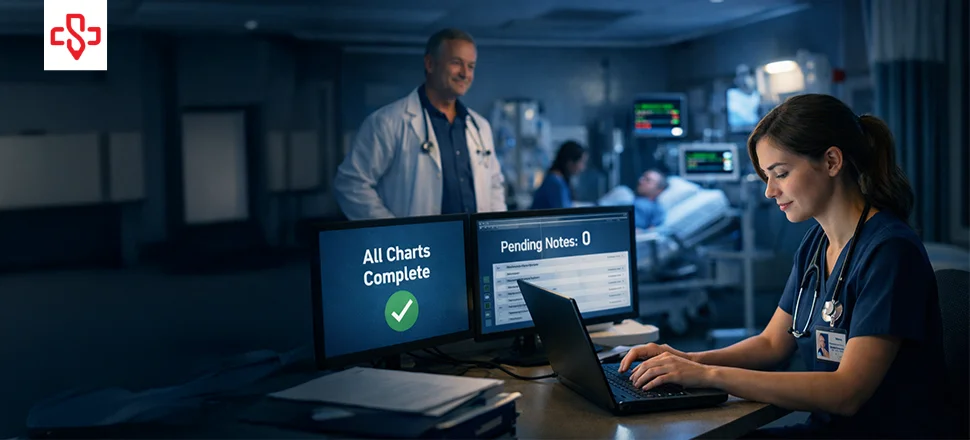
Emergency departments operate around the clock, but night shifts come with unique challenges—reduced staffing, heavier documentation load, and a steady flow of patients with unpredictable needs. When clinicians are stretched thin during overnight hours, documentation backlogs quickly pile up, leading to delayed charting, lower productivity, and increased burnout. This is where ER scribe night shift support becomes invaluable.
ER scribes are trained professionals who assist emergency providers by handling real-time documentation, data entry, and workflow support. Their presence during night shifts not only keeps charts accurate and timely but also prevents the cumulative documentation burden that often overwhelms clinicians by morning.
This blog explores how ER scribes streamline night shift operations, reduce backlogs, and improve overall emergency department efficiency.
The Night Shift Challenge: Why Documentation Backlogs Occur
Night shift presents a distinct set of pressures:
- Lower staffing compared to daytime
- Higher patient-to-provider ratio
- Increased cases involving trauma, intoxication, or acute conditions
- Fewer support resources available during overnight hours
Providers frequently find themselves multitasking at an intense pace—stabilizing patients while simultaneously trying to capture detailed documentation. By the time the shift ends, many clinicians still have hours of charting left to complete. This not only delays patient records but also contributes heavily to provider fatigue.
Several studies have found that emergency physicians spend a large portion of their shift on documentation or electronic data entry, with one well‑cited paper reporting that physicians in an ED spent around 43% of their time on EHR data entry and only 28% on direct patient care.
ER scribe night shift support directly addresses these pain points by ensuring that documentation is completed in real time, not after the fact.
How ER Scribes Keep Night Shift Documentation on Track
1. Real-Time Charting for Every Patient Encounter
The primary role of an ER scribe is to accompany the provider throughout the patient visit and document the entire encounter in the EHR. During the night shift, this real-time documentation is crucial because providers often see back-to-back patients with no downtime.
By charting as the encounter unfolds, scribes ensure:
- Notes are completed before the provider moves to the next case
- No details are forgotten or delayed
- Providers don’t accumulate documentation tasks toward the end of the shift
This directly prevents the typical “end-of-night pileup.”
2. Faster Throughput During High-Volume Hours
Emergency departments often experience spikes late at night—trauma cases, alcohol-related incidents, urgent care overflow, and more. With an ER scribe on duty, providers move through assessments more quickly because they’re not pausing to document every detail.
This helps maintain patient flow and reduces overall wait times, even during peak night hours and also manage high-pressure situations.
3. Support for Critical Documentation Requirements
Night shift cases often involve:
- Motor vehicle accidents
- Psychiatric evaluations
- Acute cardiac symptoms
- Stroke alerts
- Trauma activation
These encounters require meticulous documentation for both clinical accuracy and compliance. ER scribes ensure that:
- ROS and HPI are complete
- Critical care time is accurately logged
- Procedures are properly documented
- Medical decision-making is captured thoroughly
This not only improves patient safety but also protects the facility from compliance gaps and billing inaccuracies.
The Mid-Shift Advantage: Strengthening Provider Focus and Reducing Fatigue
Midway through a night shift, fatigue sets in—providers begin to feel the impact of continuous multitasking. This is where the Role of an Emergency Medicine Scribe becomes even more critical.
ER scribes reduce cognitive load by handling:
- Documentation
- Order tracking
- Lab and imaging follow-ups
- Note formatting
- Data entry into templates and EHR sections
This frees providers to focus solely on clinical decisions. As a result:
- Clinical accuracy improves
- Mistakes caused by fatigue decrease
- Providers maintain faster workflows even in late-night hours
Night shift feels significantly more manageable when the provider is not bogged down by EHR demands.
Morning Without Backlogs: Why ER Scribe Night Shift Support Matters
A major benefit of having scribes on night shift is ensuring that incoming morning teams don’t inherit incomplete charts. When charts remain unfinished overnight, it causes delays in:
- Billing
- Provider sign-offs
- Morning patient transitions
- Care coordination for admitted patients
With ER scribes, charting is complete before shift change, creating a smoother, more efficient workflow for the entire ED.
The ROI of ER Scribes in Night Shift Operations
Hospitals often evaluate whether staffing ER scribes overnight is worth the cost. The ROI of ER Scribes becomes clear when examining their contributions:
1. Increased Provider Productivity
Scribes allow providers to see more patients per shift without sacrificing quality. Even a modest increase in productivity leads to substantial revenue gains.
2. Improved Documentation Accuracy
Accurate charts mean:
- Higher coding levels
- Reduced downcoding
- Fewer denied claims
Better documentation directly increases revenue and reduces financial waste.
3. Less Overtime and Provider Burnout
When providers no longer stay after their shift to complete notes, the hospital saves on overtime costs and reduces burnout-related turnover.
4. Faster Throughput Improves ED Metrics
Better throughput positively affects:
- LWBS (Left Without Being Seen)
- Door-to-doc times
- Patient satisfaction scores
These impacts ultimately strengthen the ED’s financial stability and reputation.
Additional Benefits Beyond Documentation
ER scribes also contribute to the night shift environment in other meaningful ways:
Better communication between clinical teams—scribes help relay updates and track lab/imaging statuses.
Improved teaching environment—residents and medical students benefit from scribes reducing administrative workload.
Higher morale for providers—knowing documentation is handled makes the night shift far more manageable.
This all contributes to a more efficient, stable emergency department.
As the demand for timely and accurate documentation continues to rise, the role of an emergency medicine scribe becomes even more essential during overnight hours. Their presence ensures that every detail of the patient encounter is captured, even during the busiest or most fatigue-heavy parts of the shift. Night shift providers can rely on scribes not only for documentation, but also for workflow optimization, order tracking, and overall support, which directly reduces backlogs and enhances patient care delivery.
Conclusion: A Smarter Solution for Overnight Efficiency
Night shift documentation backlogs don’t just create administrative pain—they affect billing accuracy, patient safety, provider well-being, and overall department performance. By implementing ER scribe night shift support, healthcare facilities can transform the way their emergency departments operate overnight.
With real-time documentation, improved accuracy, better patient flow, and a strong return on investment, ER scribes are a crucial asset for any ED seeking to reduce backlogs and enhance night shift efficiency.
If your facility struggles with overnight charting delays, integrating ER scribes into your night shift team may be one of the most impactful solutions.