Medical scribes for EMTALA documentation have become a critical line of defense in every U.S. emergency department. First, a single missing timestamp can turn a routine ED visit into a federal compliance finding. Furthermore, civil monetary penalties now reach up to $129,233 per violation for hospitals with 100 or more beds. As a result, the cost of weak documentation has never been higher.
Emergency physicians understand this pressure. However, the same shift can include a trauma activation, a chest pain workup, three psychiatric holds, and a transfer to a tertiary center. Meanwhile, the EHR demands structured notes that hold up under a CMS investigator’s review. Something has to give. Unfortunately, the documentation often suffers first.
That is the gap professional ED scribes close. In this article, we walk through what EMTALA requires in the chart. Next, we explore where most documentation failures happen. Finally, we explain how a trained emergency medicine scribe cuts compliance risk without slowing the physician down.
What EMTALA Requires in the Medical Record
EMTALA sits at 42 U.S.C. §1395dd and 42 CFR §489.24. In short, it places three core duties on every Medicare-participating hospital with an ED. First, the hospital must provide an appropriate medical screening examination. Second, it must stabilize emergency medical conditions within its capability. Third, it must execute appropriate transfers when stabilization is out of reach.
Moreover, the chart must prove each duty. CMS investigators look beyond the care delivered. Instead, they look at the record itself. The non-negotiable documentation elements include:
- Central log entry for every individual who arrives at the ED. The log must show treatment, admission, stabilization, transfer, discharge, LWBS status, or refusal.
- Medical screening examination (MSE) note for every patient. A qualified clinician must perform it. Also, the screening process must match what any other patient with similar symptoms would receive.
- Stabilization documentation that shows the treatment given, the clinical response, and the determination of stability or ongoing emergency.
- Transfer certification that is explicit, timed, dated, and physician-signed. In addition, it must capture risks, benefits, consent, receiving facility acceptance, and the mode of transport.
- On-call physician response that records who was called, when, the response, and any delay or failure to appear.
- Refusal documentation for any patient who declines screening, stabilization, or transfer.
Hospitals must keep these records for at least five years for transferred patients. Furthermore, when CMS opens an investigation, surveyors typically pull at least 20 charts. They can also review up to six months of activity. Then, they compare the documentation to policies, on-call schedules, and the central log.
Where EMTALA Documentation Most Often Fails
The failure patterns are now well known after four decades of enforcement. Notably, the failures rarely involve clinicians refusing care. Instead, the chart simply fails to reflect the care delivered. Common failure modes include:
- Incomplete MSE notes. The screening exam happened. However, the note does not show the elements that prove it was appropriate, non-disparate, and within the ED’s capability.
- Implied transfer certifications. The physician made the call. Yet the chart misses the explicit risk-benefit analysis, the consent conversation, or the timestamp. As a result, CMS will not accept implied certifications.
- Thin central log entries. Sometimes, LWBS patients, elopements, and refusals slip through. Consequently, audits expose the gaps.
- Unrecorded on-call interactions. Phone consults often lack the consultant’s name, the time, or the clinical content. Later, this gap creates exposure when a transfer is questioned.
- Pregnant patient documentation. Fetal status, gestational age, and labor assessment are often inconsistent. Importantly, this is a known CMS focus area.
- Copy-forward notes. Templated language rarely reflects the actual encounter. Therefore, it weakens medical necessity and erodes the chart’s defense.
None of these failures means clinicians cut corners on care. Rather, they show a structural mismatch between ED speed and regulator precision. As we explore in our breakdown of patient safety protocols, documentation gaps and patient safety risks share the same root cause. Specifically, clinicians are stretched too thin to capture what they just did.
How Medical Scribes Strengthen EMTALA Documentation
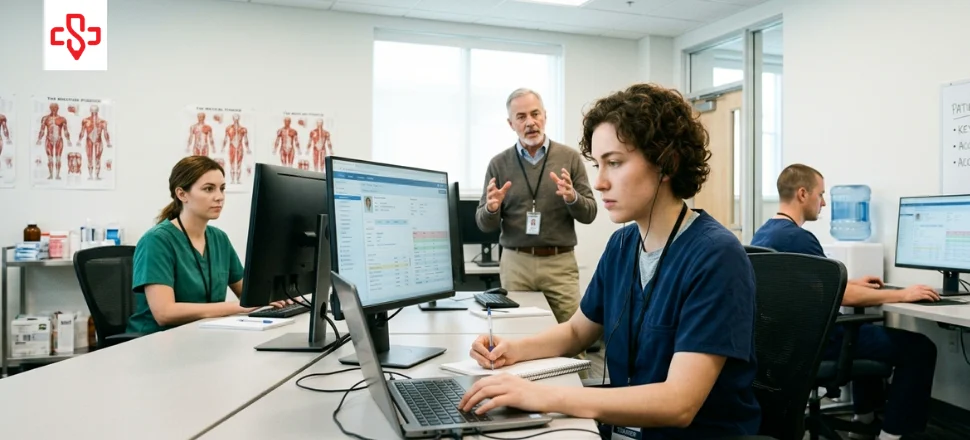
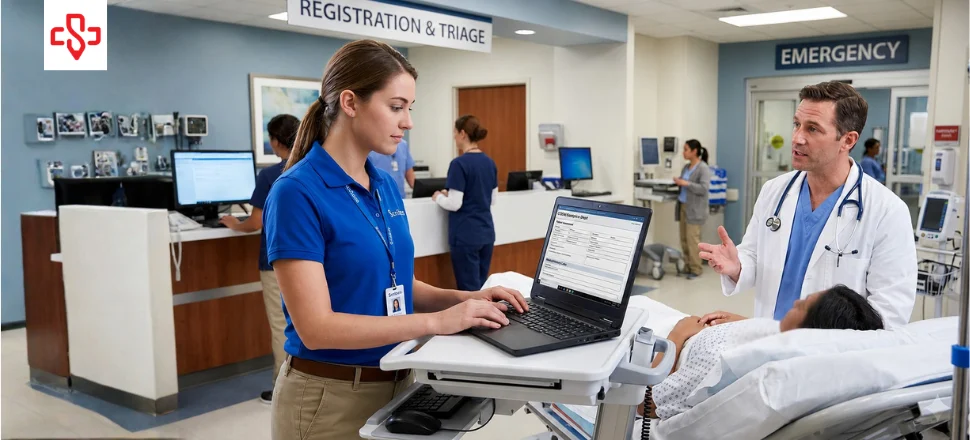
A trained ED medical scribe closes exactly these gaps. The scribe stays at the physician’s side throughout the encounter. Moreover, the scribe builds the chart in real time. As a result, the record changes in three meaningful ways:
Real-time capture of the medical screening examination
First, the scribe documents the HPI, ROS, exam findings, vitals trend, and clinical reasoning as the physician works. Pertinent positives and pertinent negatives both reach the note. This level of detail proves the MSE was appropriate for the symptoms presented. Importantly, the note reflects the encounter as it unfolded. It is not a reconstruction dictated three patients later.
Structured transfer documentation
Next, the scribe captures every key transfer element in real time. This includes the time of decision, the receiving facility, the accepting physician’s name, the mode of transport, the risk-benefit discussion, and the consent conversation. The physician then signs and timestamps the certification while the patient is still in the ED. Consequently, this single discipline eliminates the most common high-severity EMTALA citation.
On-call and consultant tracking
In addition, the scribe logs every consult call. The log includes who was called, the time placed, the callback time, the clinical guidance given, and any decision to come in. Later, if an on-call physician disputes a response time, the chart already shows the timeline.
Central log and disposition accuracy
Furthermore, the scribe tracks every disposition. This includes LWBS, AMA, MSE refusals, and patients redirected within 250 yards of the hospital. As a result, dispositions get captured rather than lost in the rush of the next arrival.
Fetal and labor assessment documentation
For pregnant patients, the scribe prompts the physician to address fetal heart tones, gestational age, contraction status, and the labor assessment. Notably, CMS surveyors routinely scrutinize each of these elements.
Defensible, encounter-specific notes
Finally, the scribe documents what the team actually says and does. Therefore, the chart avoids copy-forward and template-drift problems. The note reads like the encounter itself. That is exactly how it should read when a CMS investigator opens it 18 months later. We describe this same workflow in a scribe’s workday.
The Compliance Math: Why Documentation Quality Pays Back
Hospital leaders sometimes view scribe programs as a productivity investment. However, EMTALA reframes them as a risk-management investment. Consider the exposure:
| Exposure | Current Maximum |
|---|---|
| Civil monetary penalty per violation (hospital, 100+ beds) | Up to $129,233 |
| Civil monetary penalty per violation (hospital, under 100 beds) | Up to $64,618 |
| Civil monetary penalty per violation (physician, including on-call) | Up to $129,233 |
| Medicare provider agreement | Termination possible for gross or repeated violations |
| Private right of action | Patients and receiving facilities can recover civil damages |
| CMS chart review scope per investigation | Minimum 20 charts, up to 6 months of activity |
A single documentation-driven citation can easily exceed the annual cost of a scribe program. More importantly, scribes do not just reduce penalty exposure. They also shorten chart closure times, sharpen E/M coding accuracy, reduce downcoding, and free physicians for more bedside time. In short, scribes strengthen the underlying care that EMTALA exists to protect. The same dynamic plays out across the broader medical scribing services portfolio. However, in the ED, the compliance stakes are uniquely high.
What a Scribe-Enabled ED Documentation Workflow Looks Like
A well-run ED scribe program is more than headcount. In practice, it follows a clear workflow:
- Triage and central log capture. First, the scribe confirms the patient is logged with arrival time, chief complaint, and disposition tracking from the moment of presentation.
- Real-time MSE documentation. Next, the scribe enters HPI, ROS, exam, and clinical reasoning as the physician works. Pertinent negatives also reach the note.
- Order, result, and re-evaluation tracking. Then, the scribe timestamps labs, imaging, medications, and re-exams. As a result, the stabilization narrative stays intact.
- Consult and on-call logging. The scribe captures every specialist conversation with name, time, and clinical content.
- Disposition and transfer documentation. Before the patient leaves the ED, the scribe completes discharge instructions, admission orders, AMA or LWBS notes, or full transfer certification.
- Physician review and sign-off. Finally, the physician reviews the scribe’s note, makes corrections, and authenticates the record. Importantly, the scribe never signs, never enters orders, and never makes clinical decisions.
This workflow does not change what physicians do. Rather, it changes what the chart looks like at the end of the shift. That is what drives compliance risk. For more context, see our overview of ED scribes in hospitals.
Building an ED Scribe Program That Reduces Compliance Risk
Not all scribe programs are equal. The strongest programs share a few traits:
- Emergency-specific training. Scribes earn credentials on EMTALA documentation, EHR workflows, and ED coding before they shadow a physician.
- Quality assurance with chart auditing. The QA team reviews a sample of every scribe’s notes for MSE completeness, transfer documentation, and central log accuracy.
- Coverage models matched to volume. High-volume EDs get 24/7 staffing. Community hospitals get flex coverage during peak hours.
- HIPAA and PHI discipline. Training, signed BAAs, and clear scope-of-practice boundaries keep scribes inside the four corners of documentation.
- Continuous physician feedback. The scribe team adapts to each physician’s style. At the same time, the team protects compliance fidelity.
Conclusion
EMTALA enforcement is not slowing down. In fact, CMS announced a comprehensive compliance plan. Furthermore, OIG continues to post patient-dumping enforcement actions on a regular cadence. The documentation standard surveyors apply has also become more exacting. Hospitals cannot eliminate ED volume, acuity, or regulatory load. However, they can eliminate the gap between the care delivered and the chart that records it.
A trained ED scribe sits inside that gap. Embedded in the workflow, the scribe captures the screening exam, the stabilization, the consults, the transfer certification, and the disposition in real time. As a result, the scribe turns EMTALA compliance from a post-shift cleanup task into something that lives in the chart from arrival to disposition. That is the most durable way to reduce compliance risk in an emergency department.
Ready to strengthen EMTALA documentation in your ED? Talk to Scribe.ology about a scribe program designed around emergency department compliance, physician workflow, and the documentation standards CMS investigators actually apply.