
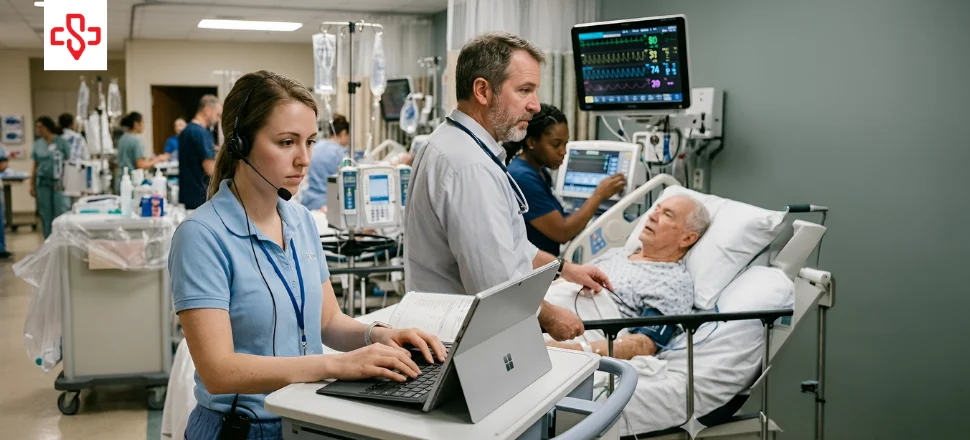
Intensive care units run on precision, speed, and relentless clinical focus. Every second a physician spends on a screen is a second lost to patient care. ICU scribing solves this problem at its root. It places a trained documentation specialist alongside the care team during complex encounters.
A 2023 study in Critical Care Medicine revealed a striking gap. Intensivists spend up to 40 percent of their shift on EHR tasks. That leaves far less time for direct patient interaction. Without a dedicated scribe, clinicians chart details retroactively, often hours later. ICU scribing eliminates this lag by capturing data in real time.
The return on this investment extends well beyond documentation quality. Scribe-assisted ICU teams completed discharge summaries 35 percent faster in a 2024 study. Those teams also captured higher-acuity DRG codes consistently. This translates directly into stronger revenue for hospital systems using dedicated scribes in critical care.
Why ICU Documentation Demands a Specialized Scribing Approach
Standard scribing protocols fall short in the ICU without major adaptation. Critical care charting demands knowledge of ventilator modes and vasopressor titration. Scribes must also understand hemodynamic monitoring and SOFA scoring frameworks. A scribe here must anticipate the physician’s workflow, not just record dictation.
Training plays a decisive role in this environment. A skilled ICU scribe knows assist-control from pressure-support ventilation. They document mode changes without needing verbal confirmation from the physician. This clinical literacy turns the scribe into an active documentation partner. The shift mirrors how live ER scribes bring order to chaotic ED workflows.
As a result, documentation reflects the full clinical picture accurately. Organizations investing in specialty scribe training see far better outcomes. Generalist scribes dropped into critical care rotations consistently underperform by comparison.
How Real-Time Clinical Scribing Protects ICU Team Efficiency
ICU scribing quietly transforms team dynamics and communication flow. Rounds involve physicians, residents, pharmacists, and respiratory therapists together. When the attending pauses rounds to update the EHR, the entire team stalls. These micro-interruptions compound across a 20-patient census quickly.
A dedicated scribe maintains the chart alongside the clinical conversation. The physician speaks, examines, and decides while the scribe documents simultaneously. Stanford’s Critical Care Department found scribe-supported rounds finished 22 percent faster. Documentation completeness remained unchanged despite the time savings. This mirrors how virtual medical scribes maintain documentation flow in remote settings.
Real-time scribing also strengthens handoff quality during shift changes. The incoming physician inherits a current, comprehensive clinical narrative at sign-out. In the ICU, a missed drip rate change can trigger adverse outcomes. Accurate, timely charts prevent these dangerous information gaps from forming.
Measuring the ROI of ICU Scribing Programs Across Hospital Systems
Administrators often evaluate scribing through a narrow cost-per-hour lens. However, ICU scribing delivers returns across multiple dimensions simultaneously. Coding accuracy improves because scribes capture full encounter complexity. ICU encounters carry the highest-value DRG codes in hospital billing. Incomplete documentation erodes that reimbursement directly, a challenge that scribe-driven RVU gains have already solved in emergency departments.
Physician retention offers another powerful return on investment. Nearly 50 percent of ICU physicians report burnout symptoms according to the Society of Critical Care Medicine. Documentation burden is consistently cited as a primary contributor. Replacing one intensivist costs a hospital between $500,000 and $1 million. A scribing program that retains even one physician per year far exceeds its own cost.
Patient safety metrics improve with scribing support as well. Complete documentation reduces medication errors and communication breakdowns. Joint Commission data links charting quality to fewer preventable adverse events. Organizations seeking a scalable medical scribing solution can match coverage to census and shift patterns.
Conclusion
ICU scribing is no longer a luxury for large academic medical centers. It has become a strategic investment in documentation, physician wellbeing, and finances. Hospitals embedding trained scribes into ICU workflows deliver safer patient care consistently.
They also retain top physicians and capture full reimbursement value. As burnout, staffing shortages, and rising acuity challenge the industry, ICU scribing remains one of the most practical solutions available today.