Physicians in hospital settings often spend more time in the EHR than at the bedside. Rounds, consults, admissions, and discharge summaries all feed the same documentation queue. As a result, that queue rarely shrinks on its own. Hospital EHR scribe services exist to close that gap. They give providers back clinical time. In addition, they keep the chart complete, accurate, and ready for billing review.
What Hospital EHR Scribe Services Actually Do
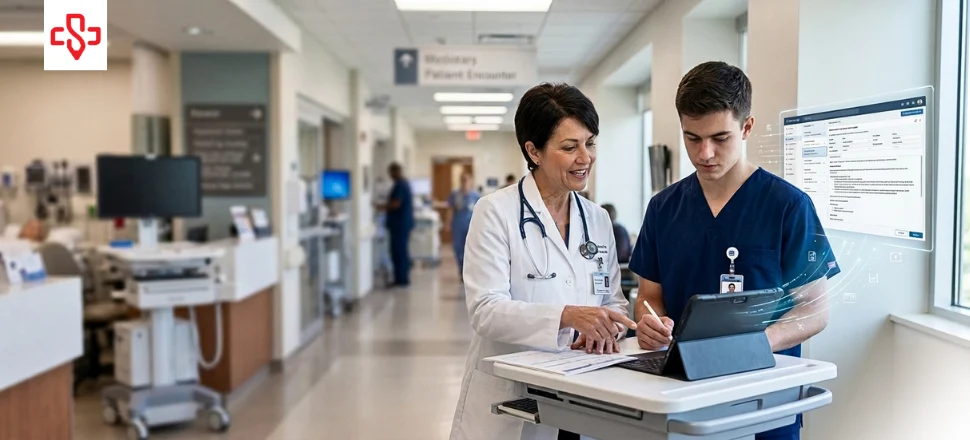
A hospital scribe works alongside a physician during rounds and patient encounters. Specifically, the scribe enters history, exam findings, orders, and treatment plans directly into the EHR efficiency workflow in real time. Because of this, a physician does not need to dictate notes after the shift ends. Instead, the scribe captures documentation as the encounter happens, so charts close same-day rather than trailing into personal time. This matters most in hospitalist and inpatient settings, where patient volume and handoff pace leave little room for after-hours charting.
The Documentation Burden Behind Physician Burnout
Hospital documentation load is not a minor inconvenience. In fact, it is one of the most consistently cited drivers behind physician burnout support needs across health systems. The table below outlines where that burden shows up and how scribe services address each point.
| Documentation Pain Point | Impact Without a Scribe | Impact With a Hospital Scribe |
|---|---|---|
| Chart completion time | Notes finished after hours or the next day | Notes completed during or right after the encounter |
| Physician-patient face time | Reduced by split attention between screen and patient | Restored, since the scribe manages the screen |
| Coding and CDI accuracy | Inconsistent detail, downstream query volume | More complete, consistent documentation for coders |
| Provider burnout risk | Elevated by after-hours “pajama time” charting | Reduced through real-time note closure |
| Patient throughput per shift | Limited by charting overhead between patients | Improved, since documentation runs in parallel with care |
Real-Time Documentation Changes the Workflow, Not Just the Paperwork
The value of a hospital scribe goes beyond typing speed. For example, a trained scribe learns a provider’s documentation style, then anticipates what needs to be captured during a fast-moving round. The scribe also flags missing details before a note is finalized. As a result, real-time documentation support means fewer late addenda, fewer compliance flags, and a more accurate first-pass chart.
Clinical research backs this up. For instance, one study looked at scribe use in an academic general medicine practice. Physicians working with scribes completed more visits per hour and also reported an improved sense of their documentation burden. Meanwhile, patient satisfaction scores did not drop.
Providers working with scribes saw more patients per hour. They also reported a meaningful improvement in how manageable their documentation load felt, with no decline in how patients rated their care.
Faster throughput and lower reported burden go hand in hand. Therefore, hospital systems increasingly treat scribe services as an operational tool, not just a clerical convenience. (Source: National Library of Medicine, PMC)
Where Scribes Fit Alongside Voice Dictation and AI Tools
Many hospitals already use voice dictation or ambient AI note generators. However, scribe services are not a replacement for that technology — rather, they are a complement to it. A human scribe can catch clinical nuance and similarly verify that orders match what was actually discussed. The scribe can also adapt instantly when a round gets interrupted; by contrast, dictation software alone cannot do that.
Supporting Revenue Integrity, Not Just Note-Taking
Incomplete or delayed documentation does not just slow physicians down. It also creates downstream problems for coding, claims, and reimbursement. For example, missing specificity in a note can trigger a coder query days later, which delays the claim and raises the risk of downcoding. Hospital EHR scribe services reduce this risk by capturing granular detail at the point of care. Consequently, that supports clinical accuracy and revenue leakage prevention across the billing cycle.
What to Look for in a Hospital Scribing Partner
Not all scribe services are structured the same way. First, look for scribes with specialty-specific training. Additionally, check for a documented onboarding process for the EHR platforms already in use. Finally, confirm that quality assurance review is built into the workflow, not just headcount. Programs that combine on-site and virtual medical scribes give departments more flexibility, which matters most for variable coverage needs like emergency medicine or high-volume hospitalist services.
The Bottom Line
Hospital EHR scribe services solve a problem technology alone has not solved. Someone has to capture a high volume of detail accurately and in real time. Moreover, that has to happen without pulling a physician’s attention away from the patient in front of them. Done well, scribing reduces after-hours charting and also improves note quality for coding and compliance. In short, it gives hospitalist and specialty teams room to see more patients without sacrificing documentation integrity.
Scribe.ology partners with hospitals and physician groups to build scribing programs around each department’s actual workflow, not a one-size-fits-all template. If your documentation backlog is hurting throughput or provider satisfaction, our team can walk through what a program would look like for your facility.