Physician Burnout Documentation Support

Reduce documentation burden, restore work-life balance — see how real-time scribe support helps physicians reclaim hours and prevent burnout.

Reduce Physician Burnout by Taking Documentation Pressure Off Providers

Physician burnout is no longer just a workforce concern. It is an operational risk that affects provider retention, patient access, documentation quality, and overall clinical productivity.

Across hospitals, emergency departments, specialty practices, and outpatient clinics, providers are spending more time inside the EHR and less time focused on the patient in front of them. Charting often extends beyond clinic hours, creating after-hours documentation burden, administrative fatigue, and reduced provider satisfaction.

Scribe.ology helps healthcare organizations address this challenge with trained medical scribes who support real-time clinical documentation, reduce EHR distractions, and help providers stay focused on care delivery.

The Problem

Documentation Is Consuming Provider Time

Modern physicians are expected to manage complex patient encounters, maintain accurate clinical documentation, meet compliance expectations, and close charts on time. For many providers, this means:

Scribe.ology has also identified “pajama time,” or after-hours charting, as a major contributor to documentation-related burnout.

90 minutes decreased productivity due to time spent entering orders into the EHR

90

95% satisfaction amongst our clients

95 %

Average 5 additional patients seen per shift

+ 5

Why Physician Burnout Becomes a Business Issue

When documentation pressure increases, the impact extends beyond the individual provider. Healthcare organizations may experience:

A qualitative study on medical scribes found that providers reported improved job satisfaction and reduced burnout when scribes reduced their documentation burden.

How Scribe.ology Helps

Scribe.ology provides trained medical scribes who assist providers by capturing encounter details in real time and supporting accurate EHR documentation. This allows physicians to maintain patient connection while reducing the administrative load associated with charting.

Our scribe support can help healthcare teams:

Scribe.ology already supports hospitals, virtual care, outpatient practices, and emergency department environments, making the model adaptable across different clinical workflows.

Best-Fit Care Settings

This solution is especially relevant for

High-volume outpatient clinics

Emergency departments

Specialty practices

Hospitals and health systems

Telehealth programs

Growing practices adding new providers or locations

Why Choose Scribe.ology

Scribe.ology’s approach is built around provider efficiency, documentation support, and workflow alignment. Rather than adding another administrative layer, our scribes integrate into the clinical process so providers can focus on diagnosis, treatment, communication, and patient care.

For organizations facing documentation fatigue, provider dissatisfaction, or EHR inefficiency, Scribe.ology offers a practical way to reduce burnout without compromising documentation quality.

frequently asked questions

How does documentation burden contribute to physician burnout?

Charting and EHR work routinely spill into evenings and weekends — often called “pajama time” — adding hours of uncompensated work to a physician’s day. This chronic after-hours burden is one of the most consistently cited drivers of exhaustion and burnout in national physician surveys.

Time savings and burnout relief go hand in hand. When a scribe handles real-time note-taking and chart updates, physicians reclaim hours previously spent finishing documentation at home, which directly reduces the after-hours workload tied to emotional exhaustion.

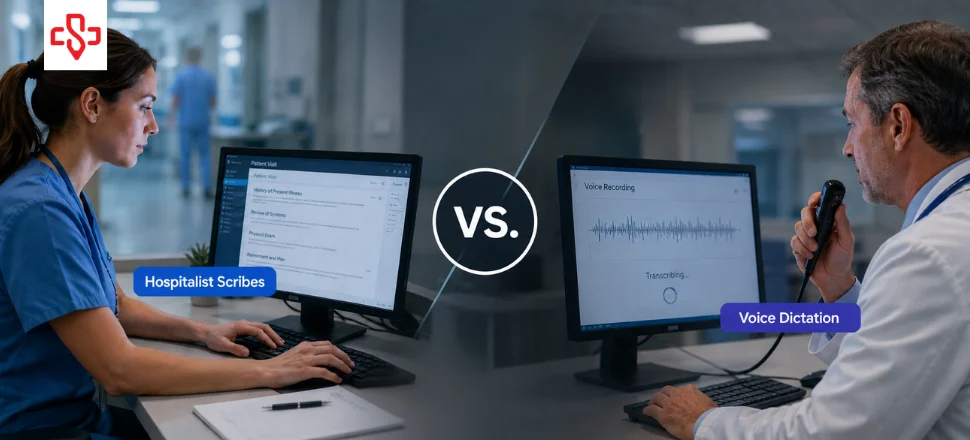
Dictation software still requires the physician to actively narrate and later review or correct notes, adding a second task on top of the patient encounter. A live scribe captures documentation in real time during the visit, removing that task from the physician’s plate entirely rather than just changing how it’s done.

Many physicians report reduced after-hours charting within the first few weeks of onboarding a scribe, though full workflow integration and burnout metrics tend to show meaningful improvement over a full quarter as the scribe becomes familiar with the physician’s style and specialty.

Yes — when physicians aren’t splitting attention between the patient and the keyboard, they can maintain eye contact and engagement during the visit itself. Many physicians also report that offloading documentation lets them make more thorough, accurate notes since a scribe captures details in real time rather than from memory afterward.

Our Recent Posts