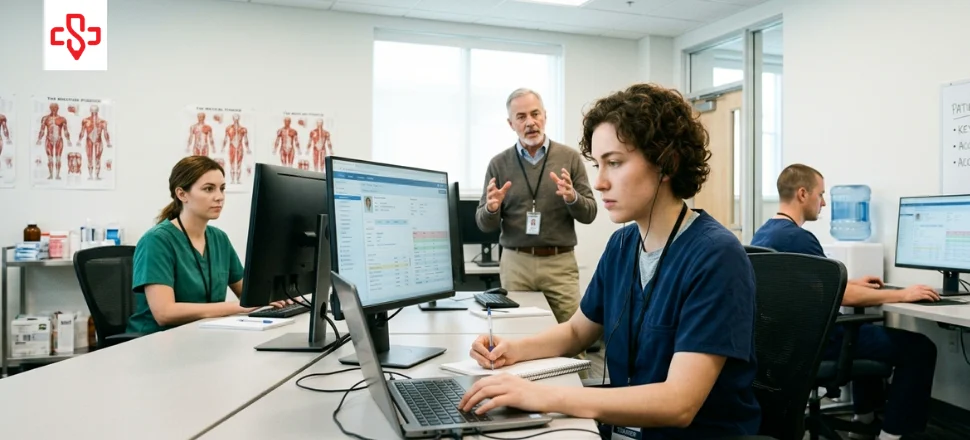

Psychiatry depends on deep listening, empathy, and strong therapeutic connections. Yet many psychiatrists struggle to maintain that connection. Documentation constantly interrupts their focus. Between session notes, EHR updates, compliance tasks, and medication histories, providers spend 35–45% of their workday on admin. That is time taken directly from patient care. A psychiatric scribe changes this dynamic. The scribe captures clinical details in real time.
This allows the psychiatrist to give undivided attention to the patient. By improving accuracy, streamlining workflows, and cutting administrative burden, a psychiatric scribe helps mental health providers reclaim their time. The result is more compassionate, effective care. Here is how.
1. Boosts Provider Efficiency and Clinical Focus
Psychiatrists often evaluate mood, affect, and thought process while typing into an EHR. Both tasks suffer when done together. A psychiatric scribe removes this problem entirely. The scribe handles note-taking, medication updates, and chart entries during or right after sessions. The provider can then focus fully on verbal and nonverbal cues.
Without a scribe, a 30-minute session often stretches to 45 minutes with charting. Or the provider finishes notes after hours. With a psychiatric scribe, documentation is done before the provider leaves. Continuity of care improves. Patient throughput increases. And emotional bandwidth is preserved. This is the same efficiency gain that physicians across specialties experience with trained scribes. In mental health, where sessions are longer and more emotionally demanding, the impact is even greater.
2. Improves Documentation Accuracy and Consistency
Psychiatric notes require exceptional precision. A subtle shift in affect, a change in sleep patterns, or a mention of suicidal ideation — these details shape diagnosis and treatment. When providers self-document under time pressure, missed details and inconsistent formatting become common.
A trained psychiatric scribe captures these subtleties in real time. They maintain uniform structure, complete all required fields, and reduce errors. Unlike general scribes, a psychiatric scribe understands qualitative symptom language. They know that clinical nuance can separate two closely related diagnoses. This precision builds on the core duties and standards every professional scribe is trained to uphold.
3. Strengthens Patient-Centered Care
Psychiatric appointments often involve sensitive topics. Patients may discuss trauma, anxiety, depression, grief, or psychotic symptoms. When a psychiatrist splits attention between the patient and a screen, emotional distance grows. The therapeutic alliance weakens at the moment it matters most.
A psychiatric scribe solves this. The provider can maintain eye contact and active listening throughout the session. Patients feel heard. Trust deepens. Disclosure becomes more open. This leads to better assessments and stronger treatment plans. It reflects the broader value scribes bring to mental healthcare, where the provider-patient relationship drives outcomes.
Psychiatry Practice: With vs. Without a Psychiatric Scribe
| Area | Without a Psychiatric Scribe | With a Psychiatric Scribe |
|---|---|---|
| Documentation time | 35–45% of workday spent on charting | Charts completed during the session |
| After-hours charting | 1–2 hours per evening on unfinished notes | Eliminated — notes closed before end of day |
| Patient eye contact | Frequently broken by screen interaction | Maintained throughout the full session |
| Note accuracy | Higher risk of missed details and errors | Real-time capture with consistent formatting |
| Provider burnout | 50%+ report burnout symptoms | 30–40% reduction with scribe support |
| Claim denials | Incomplete notes lead to frequent denials | Accurate coding reduces denials significantly |
| Patient throughput | Limited by documentation bottlenecks | More patients per day without quality loss |
| Telehealth readiness | Provider manages tech and charting alone | Virtual scribe handles documentation remotely |
4. Upholds Ethics and Confidentiality
Confidentiality is non-negotiable in psychiatry. A psychiatric scribe follows strict HIPAA protocols and mental health–specific ethical guidelines. They record clinical facts impartially. There is no interpretation, no personal judgment, and no bias. Sensitive information is handled with complete discretion.
A psychiatric scribe also understands unique privacy demands. These include substance use disclosures, domestic violence histories, and involuntary hold documentation. This specialized awareness protects patients and upholds professional integrity. For more on how scribes navigate these responsibilities, see the ethics of medical scribing.
5. Reduces Provider Burnout
Mental health providers face some of the highest burnout rates in medicine. Over 50% of psychiatrists report burnout symptoms. The cause is clear: emotional patient care combined with hours of after-hours charting. This erodes empathy, increases errors, and pushes providers out of the profession early.
A psychiatric scribe handles the documentation that follows providers home. After-hours charting is eliminated. Work-life balance is restored. Research shows burnout drops when scribes are used. Clinician satisfaction and retention improve measurably.
6. Streamlines Revenue and Compliance
Accurate documentation directly affects billing. Incomplete notes, missed diagnoses, or wrong codes lead to claim denials. Payment delays and audit risk follow. These problems compound fast in high-volume practices.
A psychiatric scribe ensures notes are complete and correctly structured. They capture session duration, decision-making complexity, and treatment changes. This supports accurate CPT and E/M coding. It also aligns documentation with payer requirements. The result is fewer denials, faster reimbursement, and stronger audit readiness.
7. Supports Research and Data Insights
For psychiatrists in academic or clinical research, accurate records are essential. A psychiatric scribe maintains structured data that supports pattern tracking and outcome analysis. Confidentiality is preserved throughout.
Researchers spend less time managing records and more time on analysis. Real-time charting produces cleaner data than retrospective self-documentation. This is a major advantage for practices contributing to published studies or institutional reviews.
8. Adapts Seamlessly to Telehealth and Hybrid Models
Telepsychiatry has expanded access to mental healthcare dramatically. Virtual psychiatric scribes have evolved with it. They connect to remote sessions through encrypted, HIPAA-compliant platforms. Documentation happens in real time — just like in-person support.
Whether a practice is fully in-person, fully remote, or hybrid, a psychiatric scribe delivers consistent documentation quality. Scribe.ology supports this through its virtual medical scribe services, which integrate into telepsychiatry workflows without compromising accuracy or compliance.
Empowering Mental Health Care Through Scribing
Adding a psychiatric scribe is more than a staffing decision. It is a strategic investment in better care, efficiency, and provider well-being. Scribes ease admin burdens, improve accuracy, and support ethical documentation. Psychiatrists can focus on what they trained to do: healing minds and improving lives.
Ready to enhance your psychiatry practice? Contact Scribe.ology today for a customized solution that fits your workflow, specialty, and care model.