Emergency departments operate in one of the most fast-paced and high-pressure environments in healthcare. Physicians, nurses, and clinical staff must make rapid decisions while managing high patient volumes, critical medical conditions, and strict compliance requirements. At the same time, they are expected to maintain accurate and complete emergency department documentation for every patient encounter.
Although electronic health records (EHRs) were introduced to improve efficiency, documentation demands in emergency medicine have continued to increase. As a result, many emergency physicians spend significant time charting during and after shifts, contributing to workflow disruptions and provider burnout.
To address these challenges, many hospitals and healthcare systems are turning to ER scribes. By assisting physicians with real-time documentation, ER scribes help reduce administrative burden, improve chart accuracy, and support more efficient emergency department operations.
Why Emergency Department Documentation Is So Complex
Unlike many outpatient specialties, emergency medicine involves unpredictable patient volumes and rapidly changing clinical situations. Physicians may treat minor injuries, trauma cases, cardiac emergencies, respiratory distress, and critical care patients all within the same shift.
Consequently, emergency department documentation requires:
- Rapid chart completion
- Accurate time-sensitive records
- Detailed clinical histories
- Procedure documentation
- Medical decision-making support
- Compliance with billing regulations
- Coordination across multiple care teams
Because of these demands, many healthcare organizations explore ER scribe services to improve documentation efficiency in high-volume emergency settings.
The Growing Documentation Burden in Emergency Medicine
Emergency physicians face constant pressure to balance patient care with documentation responsibilities. While providers focus on stabilizing patients and making urgent clinical decisions, EHR systems require detailed charting for coding, billing, legal protection, and compliance purposes.
Additionally, emergency departments often experience:
- Overcrowding
- Frequent interruptions
- High patient turnover
- Limited provider time
- Staffing shortages
- Complex patient cases
As a result, physicians frequently complete documentation after shifts have ended. This “after-hours charting” contributes significantly to provider fatigue and burnout.
Many hospitals evaluating workflow improvements first review how ER scribes help reduce patient safety protocol while also supporting faster documentation workflows.
Common Emergency Department Documentation Challenges
High Patient Volume
Emergency departments often experience unpredictable surges in patient visits. During busy periods, physicians may struggle to maintain accurate documentation while simultaneously managing patient flow.
Incomplete or delayed charting can create operational bottlenecks, increase coding risks, and delay care coordination across departments.
Time-Sensitive Documentation Requirements
Emergency medicine relies heavily on precise timestamps and detailed records. For example, physicians must accurately document:
- Arrival times
- Triage details
- Medication administration
- Procedures performed
- Critical care interventions
- Discharge instructions
Even small documentation gaps can create compliance concerns or impact reimbursement accuracy.
Physician Burnout
Administrative workload remains one of the leading causes of physician burnout across healthcare. In emergency medicine, documentation demands are especially intense because providers must complete detailed charts quickly while handling constant interruptions.
According to studies from the American Medical Association, physicians consistently identify EHR-related tasks as a major contributor to stress and burnout symptoms.
Therefore, many healthcare systems are investing in burnout reduction strategies that reduce documentation pressure on providers.
Compliance and Legal Risk
Emergency departments face strict documentation requirements for coding, reimbursement, and legal protection. Incomplete records may increase:
- Claim denials
- Audit risks
- Compliance violations
- Malpractice exposure
Consequently, providers must ensure documentation remains thorough even during high-stress situations.
The Role of ER Scribes in Emergency Departments
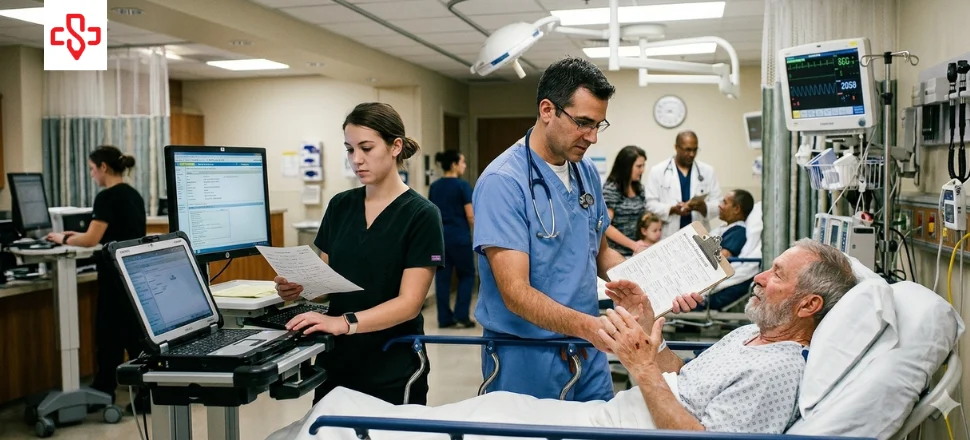
ER scribes work alongside emergency physicians to document patient encounters in real time. Instead of requiring physicians to manage every aspect of charting themselves, scribes handle much of the EHR documentation workload during patient visits.
Typically, ER scribes assist with:
- Real-time charting
- Patient history documentation
- Procedure notes
- Diagnostic updates
- EHR navigation
- Tracking lab and imaging results
- Updating discharge information
As a result, physicians can focus more fully on patient care, clinical decision-making, and department workflow management.
How ER Scribes Improve Emergency Department Efficiency
Faster Chart Completion
Because scribes document encounters during patient visits, physicians often complete charts much faster. This reduces after-hours documentation and improves overall workflow efficiency.
Additionally, faster chart completion can help support:
- Improved coding turnaround
- Cleaner claims submission
- Better revenue cycle performance
- Reduced documentation backlog
Improved Physician Productivity
When physicians spend less time typing and navigating EHR systems, they can often see more patients efficiently without sacrificing documentation quality.
Consequently, many emergency departments use live medical scribe services to support high-volume clinical workflows and reduce administrative interruptions.
Better Patient Interaction
Documentation demands can distract physicians from direct patient communication. However, ER scribes help providers spend more time maintaining eye contact, listening actively, and engaging with patients during encounters.
This often improves patient satisfaction while allowing physicians to remain more focused during critical care situations.
Reduced Cognitive Burden
Emergency medicine requires rapid clinical decision-making under pressure. Constant documentation responsibilities can increase cognitive fatigue and mental overload.
By reducing administrative distractions, ER scribes help physicians maintain focus on patient evaluation, treatment planning, and emergency response coordination.
The Financial Impact of Documentation Challenges
Poor emergency department documentation does not only affect physician workload. It can also create financial consequences for healthcare organizations.
Incomplete or delayed documentation may lead to:
- Missed billing opportunities
- Coding inaccuracies
- Claim denials
- Reduced reimbursement
- Compliance penalties
According to healthcare industry reports, documentation inefficiencies can significantly impact hospital revenue cycle performance and operational costs.
Therefore, many organizations view ER scribes not simply as documentation support staff, but as operational investments that improve efficiency and reduce administrative waste.
Why Many Hospitals Are Outsourcing ER Scribes
Building and managing an internal scribe program can require significant recruitment, training, and staffing resources. As a result, many healthcare organizations choose outsourced ER scribe programs instead.
Outsourced ER scribe providers often offer:
- Specialty-trained scribes
- Flexible staffing coverage
- Scalable support models
- Reduced hiring burden
- Quality assurance oversight
- EHR experience
Furthermore, outsourced programs allow hospitals to scale documentation support quickly without increasing internal administrative workload.
The Future of Emergency Department Documentation
As emergency departments continue facing rising patient demand and growing documentation complexity, efficient charting workflows will become even more important.
Although technology and EHR optimization may improve some administrative processes, many healthcare organizations recognize that human documentation support remains essential in fast-paced emergency environments.
ER scribes continue to play an increasingly important role in helping physicians manage documentation demands while maintaining quality patient care.
Final Thoughts
Managing emergency department documentation is one of the most challenging aspects of emergency medicine today. High patient volumes, compliance requirements, EHR complexity, and physician burnout continue to place pressure on emergency departments nationwide.
However, ER scribes provide a practical solution by reducing documentation burden, improving workflow efficiency, and supporting more accurate real-time charting. By allowing physicians to focus more on patient care instead of administrative tasks, ER scribes help emergency departments operate more efficiently during even the busiest shifts.
At Scribe.ology, our experienced ER scribes are trained to support fast-paced emergency care environments with accurate, HIPAA-compliant documentation assistance. Whether hospitals need onsite or remote support, our solutions are designed to improve physician productivity, reduce after-hours charting, and strengthen overall workflow performance.