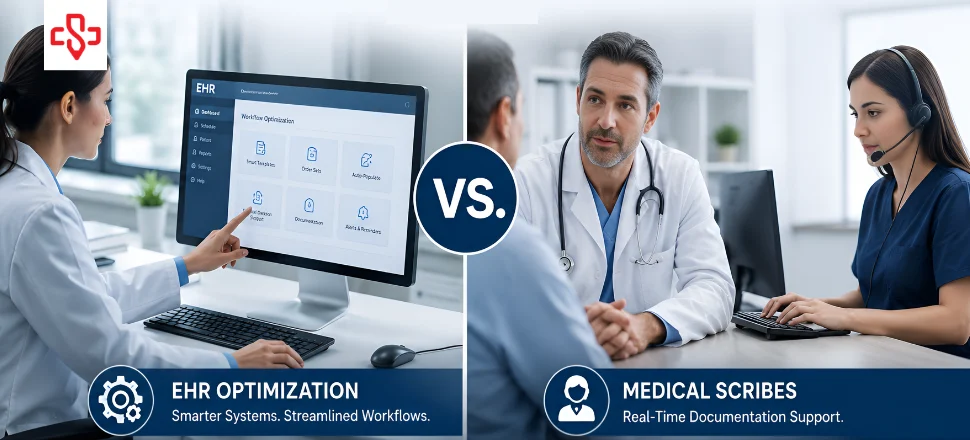
Healthcare organizations today face increasing pressure to improve efficiency while managing growing documentation demands. As a result, physicians spend a significant portion of their workday interacting with electronic health records (EHRs), often leading to frustration, burnout, and reduced patient engagement. Consequently, many practices are now exploring solutions that can reduce administrative overload without compromising patient care.The discussion around EHR optimization vs. medical scribes continues to grow because both approaches aim to reduce physician workload and improve operational efficiency.
However, each solution works differently and delivers results at different speeds.
While EHR optimization focuses on improving system usability and workflow efficiency, medical scribes directly reduce physician documentation responsibilities in real time. Therefore, understanding how each approach works can help healthcare organizations determine which solution reduces documentation burden faster and delivers the greatest operational impact.
Why Documentation Burden Has Become a Major Healthcare Challenge
Over the last decade, documentation requirements have expanded dramatically. In addition, physicians are now expected to maintain detailed patient records, support compliance standards, complete coding documentation, and manage EHR workflows while still delivering high-quality patient care.
According to a study published in the Annals of Internal Medicine, physicians spend nearly two hours on EHR and desk work for every one hour of direct patient care. Therefore, growing administrative responsibilities continue to contribute to provider dissatisfaction and operational inefficiencies across healthcare systems.
Because of these challenges, many healthcare organizations first explore medical scribes when evaluating ways to reduce documentation pressure on providers.
What Is EHR Optimization?
EHR optimization refers to improving how healthcare organizations use their electronic health record systems. Typically, this process includes:
- Customizing templates
- Improving workflow design
- Reducing unnecessary clicks
- Enhancing order entry processes
- Implementing automation tools
- Improving provider training
Essentially, the goal of EHR optimization is to make documentation faster and more efficient without replacing existing systems.
For some organizations, optimization can improve workflow consistency and reduce small inefficiencies. However, physicians still remain responsible for entering large amounts of clinical information themselves.
What Are Medical Scribes?
Medical scribes assist physicians by documenting patient encounters in real time within the EHR. Instead of requiring providers to complete extensive charting independently, scribes manage much of the documentation workload during patient visits.
Typically, medical scribes can:
- Document patient histories
- Update clinical notes
- Record diagnoses and treatment plans
- Manage EHR navigation
- Assist with chart completion
- Reduce after-hours documentation
Additionally, organizations comparing workflow strategies often evaluate AI vs. human scribes to determine which solution offers the highest documentation accuracy and provider support.
EHR Optimization vs. Medical Scribes: Key Differences
| Factor | EHR Optimization | Medical Scribes |
|---|---|---|
| Primary Goal | Improve system efficiency | Reduce physician documentation workload |
| Implementation Speed | Moderate to slow | Often faster |
| Provider Documentation Responsibility | Still handled by physician | Shared with scribe |
| Workflow Disruption | Can require retraining | Usually minimal |
| Burnout Reduction | Moderate improvement | Often significant improvement |
| After-Hours Charting | Reduced slightly | Reduced substantially |
| Scalability | Depends on system capabilities | Flexible staffing models available |
Which Solution Reduces Documentation Burden Faster?
Although both approaches can improve efficiency, medical scribes typically reduce documentation burden faster because they directly remove tasks from physicians instead of simply streamlining them.
On one hand, EHR optimization improves workflows incrementally. For example, providers may save a few clicks or shorten documentation steps. However, they still remain responsible for entering large amounts of clinical information.
On the other hand, medical scribes immediately shift much of the documentation workload away from physicians. As a result, organizations often see quicker improvements in:
- Provider productivity
- Patient interaction
- Chart completion times
- After-hours workload
- Physician satisfaction
Furthermore, healthcare systems looking for rapid workflow support frequently implement live scribe programs to maintain consistent documentation coverage across departments.
The Impact on Physician Burnout
Physician burnout remains one of the largest operational concerns in healthcare today. More importantly, documentation burden plays a major role in physician stress and dissatisfaction.
According to research from the American Medical Association, physicians commonly identify administrative workload and EHR documentation as major contributors to burnout symptoms.
Although EHR optimization may improve usability, it does not fully eliminate the cognitive load associated with charting. Instead, physicians still spend considerable mental energy managing documentation during and after patient visits.
By comparison, medical scribes reduce this burden more directly by allowing providers to focus primarily on patient care and clinical decision-making. Consequently, many organizations exploring burnout reduction strategies view medical scribes as a practical long-term solution.
Patient Experience Considerations
Documentation burden not only affects physicians but also impacts patient experience. For instance, providers distracted by screens and data entry may struggle to maintain meaningful patient interaction during appointments.
While EHR optimization can improve workflow efficiency somewhat, physicians still remain heavily involved in documentation tasks throughout encounters.
In contrast, medical scribes help providers spend more time maintaining eye contact, listening actively, and engaging with patients rather than focusing on typing and navigation.
Similarly, in high-volume environments, healthcare organizations often utilize ER scribes to improve both documentation speed and patient flow efficiency.
Cost Considerations
Some healthcare leaders initially assume EHR optimization is less expensive than hiring scribes. However, optimization projects can become costly due to:
- Consulting fees
- Software customization
- Provider retraining
- Workflow redesign
- IT resource allocation
Moreover, optimization alone may not produce enough efficiency improvement to significantly reduce burnout or increase provider capacity.
Meanwhile, medical scribes often generate operational returns through:
- Increased patient throughput
- Faster chart completion
- Improved coding accuracy
- Reduced overtime documentation
- Higher provider retention
Additionally, organizations managing multiple specialties may benefit from specialty-specific scribes trained for unique documentation workflows.
Can EHR Optimization and Medical Scribes Work Together?
In many cases, the most effective solution is not choosing one over the other. Instead, healthcare organizations often achieve the best results by combining optimized EHR workflows with medical scribe support.
For example, EHR optimization can reduce unnecessary workflow inefficiencies, while scribes remove a large portion of the documentation workload itself.
Together, these strategies can:
- Improve provider efficiency
- Reduce physician burnout
- Enhance patient interaction
- Improve chart accuracy
- Support revenue cycle performance
As a result, practices evaluating long-term workflow improvements frequently compare in-person and remote scribe models to determine the best operational fit.
Final Thoughts
Ultimately, the discussion around EHR optimization vs. medical scribes comes down to how quickly organizations need relief from documentation burden and how much physician workload they want to reduce.
Although EHR optimization can improve workflows gradually, physicians still remain responsible for most charting tasks. In contrast, medical scribes provide faster documentation relief by directly reducing administrative responsibilities during patient encounters.
Therefore, for healthcare organizations struggling with provider burnout, after-hours charting, declining productivity, or growing patient demand, medical scribes often deliver faster and more noticeable operational improvements.
As healthcare documentation demands continue to grow, many organizations are realizing that optimizing technology alone is not always enough. Instead, supporting physicians with dedicated documentation assistance may be one of the most effective ways to improve both provider satisfaction and patient care outcomes.