
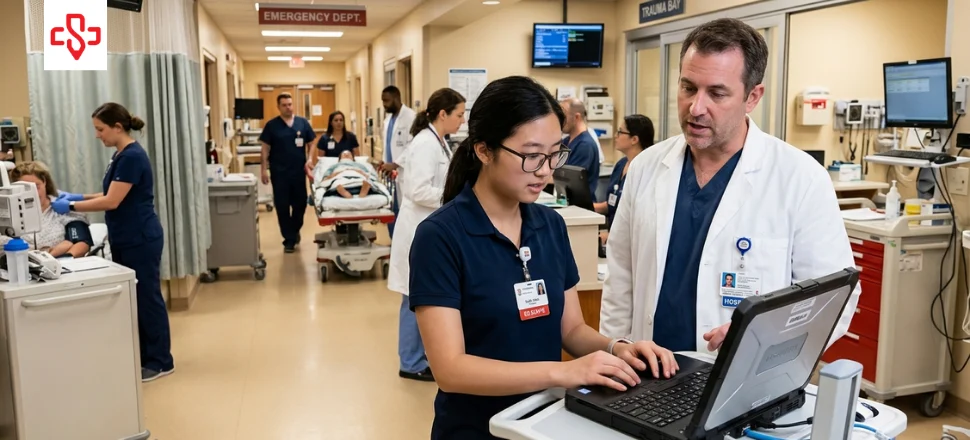
When a patient walks into an emergency department and leaves before a physician sees them, that event counts as a Left Without Being Seen—or LWBS. ED administrators watch this metric closely. High LWBS numbers point to longer wait times, strained workflows, and patients who either seek care elsewhere or worsen at home. For this reason, understanding how emergency scribes reduce LWBS rates has never been more relevant for departments under performance pressure.
In fact, the link between documentation burden and patient walkouts is more direct than it looks. When physicians spend too much time at workstations completing charts, triage-to-physician time stretches. As a result, waiting rooms fill, patients lose patience, and walkouts rise. Medical scribes break this cycle at the source—freeing providers to move faster, see patients sooner, and keep the department flowing.
What Is an LWBS Rate and Why Does It Matter?
LWBS stands for Left Without Being Seen. Specifically, a patient registers, goes through triage, but walks out before a physician or advanced practice provider evaluates them. Hospital systems widely use LWBS as a core quality and efficiency indicator.
The consequences, however, reach well beyond satisfaction scores. Each LWBS patient represents lost revenue, a potential safety event, and reputational risk for the facility. Moreover, research in the Annals of Emergency Medicine links prolonged wait times directly to higher LWBS rates. Therefore, anything that speeds up patient flow becomes a legitimate strategy for reducing walkouts.
Most benchmarks flag LWBS rates above 2% as a concern and rates above 5% as a serious problem. In addition, busy urban EDs see those numbers climb even higher during peak hours without active intervention.
How Documentation Slowdowns Drive LWBS Events
The path from documentation delays to LWBS is straightforward. When physicians stay at EHR workstations finishing charts from earlier encounters, they cannot start new evaluations. Consequently, triage-to-physician time rises, waiting room dwell time grows, and patients with moderate-acuity complaints start weighing whether the wait is worth it.
Research shows physicians spend nearly two hours on EHR tasks for every hour of direct patient contact. In a department that never stops receiving patients, that imbalance builds a documentation backlog that compounds across a shift. For that reason, live ER medical scribes break this cycle by handling real-time documentation—keeping the physician clinically active instead of administratively stuck.
The Direct Role Emergency Scribes Play in Reducing LWBS
Emergency scribes reduce LWBS rates through several connected mechanisms. Specifically, each one targets a point in the patient flow chain where delays typically build up.
Faster Physician Availability
The biggest driver of LWBS is the gap between triage and first physician contact. When a scribe handles chart documentation during and after each encounter, the physician no longer pauses between patients to complete notes. Instead, they move directly from one evaluation to the next, compressing the triage-to-physician interval significantly.
As a result, departments using scribes report physician productivity gains of up to 15.9%, with measurable drops in patient length of stay. Shorter encounters and faster room clearance, in turn, cut wait times for patients still in the waiting area.
Real-Time Documentation Prevents Backlog
Without scribes, charts pile up quickly. A physician who falls two or three encounters behind early in a shift spends the rest of it trying to catch up. As a result, new patient contacts get delayed and LWBS risk climbs. Emergency scribes, by contrast, document each encounter as it happens—stopping backlog before it starts.
Consequently, chart completion keeps pace with patient volume instead of trailing behind it. The result is a steadier flow rate across the department—exactly what patient throughput strategies aim to achieve.
Reduced Cognitive Load on Providers
Emergency physicians who manage both patient care and their own documentation face cognitive overload during high-volume periods. That overload slows decision-making and stretches encounter time. However, when a scribe takes over the documentation layer, the physician focuses on clinical evaluation only. Encounters therefore move faster without losing quality.
Faster encounters, in turn, drive faster room turnover. The waiting room clears more quickly. As a result, patients have less time to hit the frustration threshold that sends them out the door.
Support During Peak Volume Surges
LWBS events cluster during surge periods—evenings, weekends, and flu season. These windows also push documentation burden on physicians to its peak. For this reason, emergency scribes are especially valuable during surges—they absorb the documentation spike directly, stopping it from slowing the physician at the worst possible time.
Furthermore, an emergency department scribe trained in high-acuity environments adapts to shifting priorities, maintains accurate records across multiple simultaneous encounters, and keeps documentation complete even when the department runs at capacity.
LWBS, Patient Satisfaction, and Revenue: The Connected Impact
Cutting LWBS rates does more than fix an operational number. In fact, it drives meaningful improvements in patient satisfaction scores, Press Ganey results, and CMS reimbursement tied to patient experience. Patients who wait less and reach a physician faster rate their ED visits more favorably. As a result, those ratings carry real financial weight for hospital systems.
Beyond satisfaction, the revenue picture is equally direct. Each LWBS event is a patient encounter the department never completed and never billed. Even a modest reduction in LWBS events, therefore, recovers revenue that exceeds the cost of a scribe program. Add improved coding accuracy and cleaner claims, and the financial case for emergency scribes becomes clear.
What the Data Shows
The evidence behind scribe programs in emergency medicine is strong. Specifically, departments that run dedicated scribe programs report consistent gains across the metrics tied most closely to LWBS: triage-to-physician time, door-to-discharge time, patients per hour, and physician satisfaction. Provider satisfaction matters here because burned-out physicians move more slowly, decide less efficiently, and fall further behind as shifts progress.
Importantly, when emergency scribes reduce documentation burden—the leading cause of physician burnout—the operational gains reinforce themselves. Less fatigued providers document more accurately, make faster decisions, and, as a result, sustain higher patient-per-hour rates deep into a shift.
Choosing the Right Scribe Program for Your ED
Not every scribe program delivers the same results in emergency settings. EDs need scribes with specific training for high-acuity, fast-paced documentation—not generalist scribes moving over from outpatient work. In particular, look for specialty-specific training, hands-on EHR experience in emergency medicine, and the ability to handle simultaneous patient encounters without falling behind.
In addition, a strong scribe program builds in quality oversight, scheduling aligned with ED peak hours, and clear communication protocols between scribes and providers.
Final Thoughts
Ultimately, LWBS rates expose the efficiency—or inefficiency—of the entire patient flow system. Documentation delays rank among the most controllable contributors. When emergency scribes reduce LWBS events by getting physicians back to patients faster, the benefits go well beyond one metric. Wait times drop, satisfaction improves, revenue returns, and providers deliver better, more focused care.
For emergency departments that want a practical, evidence-backed way to lower LWBS rates, a dedicated scribe program is one of the most direct options available. Scribeology’s emergency department scribe services meet these requirements directly, with training built specifically for the pace and unpredictability of emergency medicine. Contact Scribeology to find out how emergency department scribes can support your facility.