
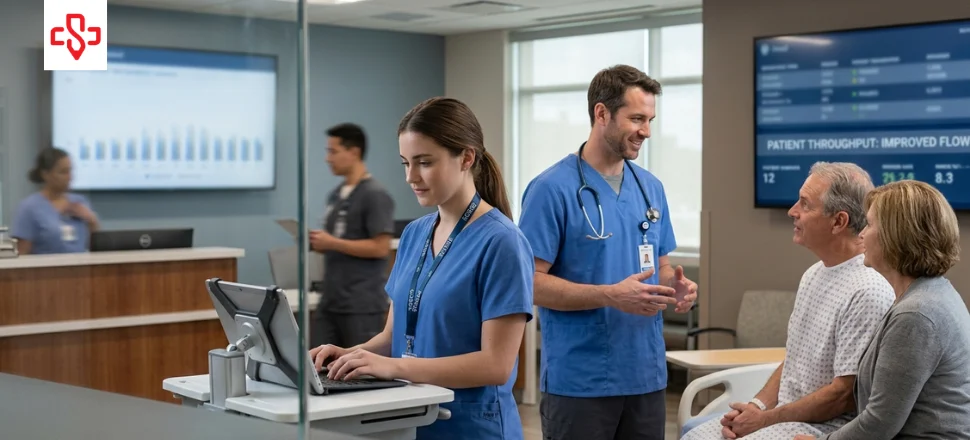
Healthcare organizations today face increasing pressure to improve efficiency while maintaining high-quality patient care. Rising patient volumes, staffing shortages, physician burnout, and growing documentation requirements continue to slow workflows across hospitals and clinics. As a result, many providers are searching for solutions that improve operational performance without compromising clinical accuracy.
One area receiving significant attention is patient throughput with a scribe. Medical scribes help physicians reduce documentation burden, improve workflow efficiency, and spend more time focusing on patient care. Consequently, healthcare organizations often experience faster patient movement, reduced delays, and improved productivity when scribes are integrated into clinical operations.
What Is Patient Throughput?
Patient throughput refers to how efficiently patients move through the healthcare process from registration to discharge. In hospitals, emergency departments, urgent care centers, and outpatient clinics, efficient throughput is essential for maintaining operational flow and patient satisfaction.
Strong patient throughput helps healthcare organizations:
- Reduce patient wait times
- Improve appointment efficiency
- Increase provider productivity
- Support faster discharge processes
- Improve patient satisfaction
- Reduce workflow bottlenecks
However, documentation requirements often slow providers down significantly during patient encounters.
Many organizations implementing live scribe support aim to improve both documentation efficiency and patient flow simultaneously.
How Documentation Affects Throughput
Clinical documentation is one of the most time-consuming responsibilities providers face each day. Physicians must complete detailed notes, review patient histories, update EHRs, document procedures, manage coding requirements, and finalize discharge instructions.
At the same time, providers are expected to maintain patient interaction quality while managing increasingly complex administrative workflows.
According to research published in the Annals of Family Medicine, physicians can spend nearly two hours on EHR and desk work for every hour of direct patient care. Consequently, documentation inefficiencies continue to reduce provider efficiency and slow patient throughput.
When physicians spend large portions of their shift charting, several operational issues may occur:
- Longer patient wait times
- Reduced appointment availability
- Slower room turnover
- Delayed discharges
- Increased provider fatigue
- Workflow congestion
What Does a Medical Scribe Do?
Medical scribes assist providers by documenting patient encounters in real time. Rather than requiring physicians to manage every aspect of charting themselves, scribes handle much of the administrative documentation workload during patient visits.
Typically, scribes assist with:
- Patient history documentation
- EHR navigation
- Procedure notes
- Clinical updates
- Diagnostic tracking
- Discharge documentation
- Chart organization
Because documentation occurs simultaneously with patient care, providers can move more efficiently between patients without falling behind on charting responsibilities.
Healthcare systems exploring virtual scribing solutions often do so to improve provider efficiency while maintaining documentation quality.
What Happens to Patient Throughput With a Scribe?
Providers Spend Less Time Charting
One of the biggest operational improvements occurs when physicians spend less time focused on documentation tasks. Scribes reduce administrative workload by handling much of the charting process in real time.
As a result, providers can focus more attention on patient evaluations, treatment planning, and clinical decision-making instead of typing notes between encounters.
Consequently, patient movement through the healthcare system often becomes faster and more efficient.
Patient Wait Times Often Improve
When physicians complete documentation more efficiently, appointment schedules tend to run more smoothly. Patients may spend less time waiting for providers, discharge paperwork, or room availability.
In busy emergency departments and outpatient clinics, even small documentation improvements can significantly affect overall throughput.
Hospitals evaluating ER documentation support frequently prioritize throughput improvements when implementing scribe programs.
Room Turnover Becomes Faster
Efficient documentation supports quicker patient transitions. Providers can finalize charts sooner, allowing rooms to become available more quickly for incoming patients.
This improvement helps reduce bottlenecks in:
- Emergency departments
- Urgent care centers
- Primary care clinics
- Specialty practices
Consequently, healthcare organizations may increase patient capacity without compromising documentation quality.
The Impact on Provider Productivity
Medical scribes often improve physician productivity because providers can focus more fully on clinical care instead of administrative tasks.
According to healthcare workflow studies, physicians using scribes may see more patients per shift while also reducing after-hours charting responsibilities. Additionally, many providers report improved work satisfaction and reduced documentation fatigue when working with scribes.
Healthcare leaders reviewing chart completion strategies often identify scribes as a major workflow improvement tool.
Patient Throughput Improvements With Scribes
| Workflow Area | Without a Scribe | With a Scribe |
|---|---|---|
| Documentation Time | High provider workload | Reduced physician charting time |
| Patient Wait Times | Longer delays | Improved patient flow |
| Room Turnover | Slower transitions | Faster room availability |
| Chart Completion | Often delayed | Completed more efficiently |
| Provider Productivity | Limited by EHR tasks | Improved clinical efficiency |
| After-Hours Charting | Frequent | Reduced significantly |
How Scribes Help Reduce Physician Burnout
Documentation overload remains one of the leading contributors to physician burnout. Many providers spend evenings and weekends completing charts after clinic hours, commonly referred to as “pajama time.”
As administrative burden increases, provider stress and fatigue often increase as well.
By reducing charting workload during patient visits, scribes help physicians maintain better workflow balance and reduce after-hours documentation responsibilities.
Many organizations exploring burnout reduction strategies recognize that documentation support directly impacts provider well-being.
The Financial Impact of Improved Throughput
Improved patient throughput benefits not only providers and patients but also healthcare organizations financially.
More efficient workflows may support:
- Higher patient capacity
- Improved reimbursement timelines
- Reduced documentation errors
- Better coding accuracy
- Cleaner claims submission
- Improved operational efficiency
Consequently, many healthcare organizations view scribes as long-term operational investments rather than simply administrative support staff.
The Growing Demand for Medical Scribes
As healthcare documentation complexity continues increasing, more hospitals and practices are investing in medical scribe programs to improve throughput and workflow efficiency.
Although EHR optimization and AI documentation tools may support some administrative tasks, human scribes continue providing valuable real-time documentation support that improves both operational flow and provider focus.
Furthermore, medical scribes help providers maintain stronger patient engagement because physicians spend less time focused on screens during encounters.
Organizations reviewing documentation workflow solutions often conclude that human scribes remain one of the most effective ways to improve throughput without sacrificing accuracy.
Final Thoughts
So, what happens to patient throughput with a scribe? In many healthcare environments, throughput improves significantly when providers receive real-time documentation support.
Medical scribes help reduce physician charting burden, improve workflow efficiency, support faster patient movement, and strengthen overall operational performance. As a result, providers can focus more on patient care while healthcare organizations improve efficiency across the entire care process.
For hospitals and practices seeking practical scribe solutions to growing documentation demands, medical scribes continue to offer one of the most effective ways to improve patient throughput and provider productivity simultaneously.