
Accurate clinical documentation is the backbone of safe, compliant hospital care. However, rising patient volumes, complex cases, and heavy EHR demands have made documentation harder than ever to get right. As a result, omissions, delayed entries, and data-entry mistakes continue to threaten patient safety and hospital compliance. Fortunately, hospitals now have a proven way to reduce hospital documentation errors: embedding trained scribes directly into clinical workflows.
This article explains how medical scribes reduce hospital documentation errors, which specific error types they prevent, and why more hospitals are expanding scribe programs across departments.
Why Documentation Errors Happen in Hospitals
Hospital environments move fast, and clinicians often juggle several patients at once while navigating dense EHR systems. In fact, research shows hospital-based providers can spend 40-50% of their working hours on documentation and EHR-related tasks alone. Under this pressure, errors creep in: incomplete histories, missing clinical details, delayed chart entries, and mistyped data.
These mistakes carry real consequences. Studies link documentation inaccuracies to care delays, billing denials, and even adverse patient outcomes. Meanwhile, surveys show more than 50% of physicians cite EHR documentation as a top driver of burnout, largely because of after-hours charting and constant corrections. Consequently, hospitals need more than software upgrades; they need dedicated human support inside the workflow itself.
How Scribes Improve Documentation Accuracy
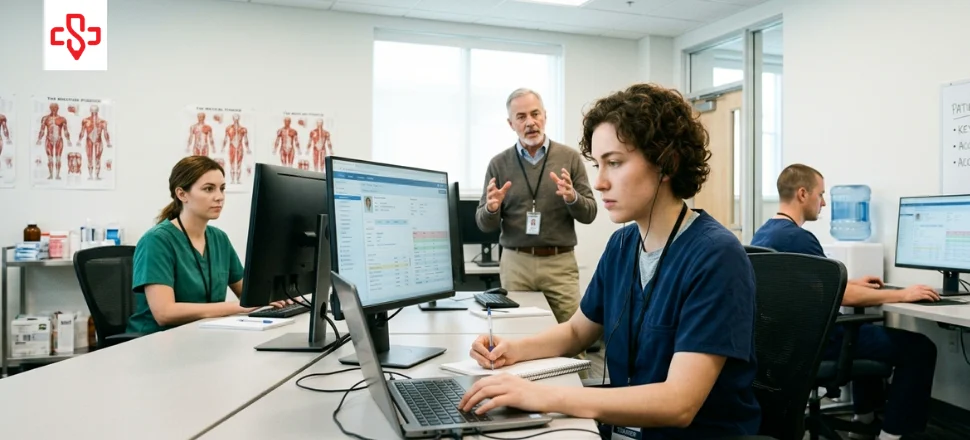
Medical scribes are trained professionals who document encounters in real time, under a clinician’s direction. Because they focus solely on charting, providers can give patients their full attention while the record stays accurate and complete. This division of labor directly strengthens scribe documentation accuracy across every department.
By listening to the conversation, watching the exam, and capturing details as they happen, hospital scribes catch information that busy clinicians might otherwise forget. Therefore, hospitals see fewer errors that typically stem from rushed or memory-based charting hours after the visit ends.
Common Errors Scribes Help Prevent
Hospitals that bring scribes into daily operations tend to see measurable drops in several recurring documentation problems:
- Omissions: Symptoms, findings, and treatment plans get captured fully, not partially.
- Inconsistencies: Standardized templates keep documentation uniform across providers.
- Delayed entries: Real-time charting supports same-day completion instead of backlogs.
- EHR navigation errors: Experienced scribes enter data into the correct fields the first time.
Altogether, these improvements help hospitals reduce hospital documentation errors while supporting safer, faster clinical decisions.
Error Rates Before and After Scribe Integration
| Documentation Issue | Without Scribes | With Scribes |
|---|---|---|
| Missed clinical details | Common, especially during high patient volume | Rare, since scribes capture details in real time |
| Chart completion time | Often delayed by hours or completed after shift | Same-day or near-immediate completion |
| Template consistency | Varies by provider and shift | Standardized across encounters |
| EHR data-entry mistakes | Higher, due to divided provider attention | Lower, since scribes focus solely on entry |
Scribes as Part of the Clinical Workflow
A hospital scribe works best as an integrated team member, not an outside add-on. Within the clinical workflow, scribes support rounds, emergency encounters, admissions, and discharge paperwork alike.
This setup lets documentation happen alongside care rather than after it. Providers maintain eye contact, communicate more clearly, and stay focused on decisions, while scribes handle the record in the background. As a result, hospitals experience fewer backlogs and noticeably smoother operations.
Strengthening Compliance and Risk Management
Accurate documentation also protects hospitals legally and operationally. Scribes help produce thorough, legible, and standardized records that support regulatory compliance and quality reporting.
Well-documented charts hold up better during audits, reduce coding discrepancies, and demonstrate adherence to clinical guidelines. In high-risk hospital settings, this accuracy plays a direct role in institutional accountability.
Better Communication Across Care Teams
Hospitals rely on clear communication across nurses, specialists, and coordinators. Unfortunately, incomplete documentation creates gaps during care transitions and handoffs.
By improving clarity and consistency, scribes help close those gaps and support smoother information sharing throughout the care team.
Provider Satisfaction and Focus
When clinicians trust their charts, they spend less time correcting records and more time with patients. Consequently, hospitals using scribes often report higher provider satisfaction, less after-hours charting, and stronger focus during clinical decision-making.
Why More Hospitals Are Expanding Scribe Programs
Given ongoing staffing shortages and rising documentation demands, scribe programs offer a scalable, practical solution. Across departments, this approach helps hospitals reduce hospital documentation errors while improving both efficiency and care quality.
Conclusion
Medical scribing plays a critical role in hospital documentation accuracy. By embedding trained scribes into daily clinical workflow, hospitals can reduce hospital documentation errors while strengthening compliance, communication, and provider well-being.
Partner With a Trusted Medical Scribing Provider
If your hospital wants to improve documentation accuracy and lighten clinician workload, partnering with an experienced provider delivers measurable results. Scribeology offers tailored medical scribing solutions built specifically for hospital environments.
Ready to strengthen documentation accuracy and workflow efficiency?
Get a customized quote today and see how professional scribing can support your hospital’s clinical and operational goals.