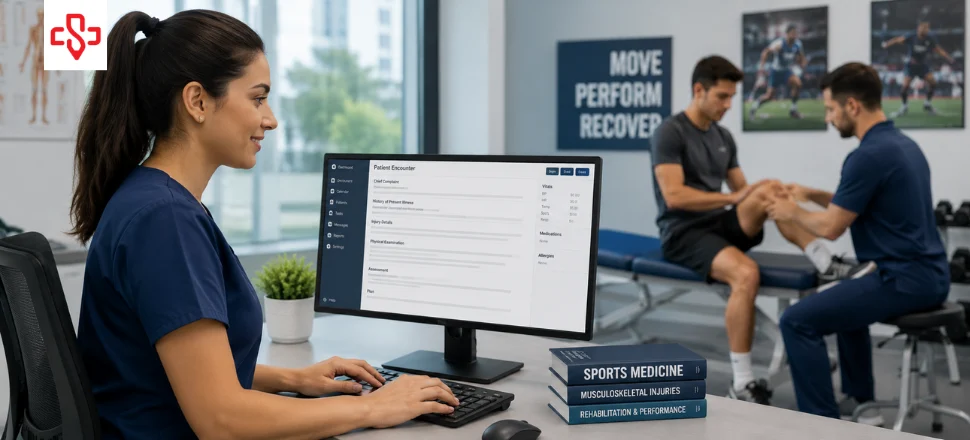
Sports medicine clinics move fast. For example, a physician might see an ACL tear, a concussion follow-up, and a return-to-play clearance within the same hour. Because of this pace, each visit requires precise, time-stamped documentation. This is where Sports Medicine Scribes earn their place on the care team. Specifically, by handling real-time charting during injury evaluations, they free physicians to focus fully on the athlete in front of them. As a result, physicians no longer have to split attention between the exam and the keyboard.
Unlike general outpatient documentation, sports medicine notes carry unique weight. For instance, they inform return-to-play decisions, insurance and workers’ compensation claims, and sometimes legal review after a serious injury. Consequently, a missed detail in an injury history can ripple into downstream care decisions weeks later. Similarly, a vague description of joint stability testing can create the same problem.
What Sports Medicine Scribes Do During Injury Evaluations
During an acute injury visit, a scribe captures the mechanism of injury and the patient’s prior injury history. In addition, they record the physician’s physical exam findings in real time, including special tests like Lachman’s or anterior drawer results. Because of this, the level of detail matters more in sports medicine than in almost any other specialty. In fact, small variances in ligament laxity grading or range-of-motion measurements can directly shape treatment pathways.
Moreover, scribes trained in orthopedic documentation already understand musculoskeletal terminology, imaging correlation, and grading scales. Therefore, this shortens the learning curve considerably compared to a general medical scribe stepping into a sports medicine clinic cold.
Supporting Return-to-Play and Performance Decisions
Return-to-play clearance is one of the highest-stakes documents a sports medicine physician produces. After all, it needs to reflect objective testing, not just a physician’s general impression. When a scribe manages this documentation, physicians can walk an athlete through strength testing, balance assessments, or cardiovascular clearance. Meanwhile, the scribe records results as they happen, rather than the physician reconstructing the visit afterward from memory.
This matters just as much for performance care as it does for injury recovery. For example, athletes working with sports medicine teams on conditioning, biomechanics, or nutrition consults generate ongoing documentation. Because of this, the documentation needs to stay consistent across multiple visits. Additionally, a scribe who tracks this longitudinally helps physicians spot patterns, like recurring overuse symptoms, that might otherwise get lost across a busy visit schedule.
Reducing Documentation Burden in High-Volume Clinics
Overall, sports medicine physicians often report some of the highest after-hours charting loads in outpatient medicine. This is especially true for those covering team events or working in high-volume sideline and clinic settings. However, offloading real-time documentation to a scribe has a measurable effect on this burden. As a result, physicians who work with scribes consistently report shorter days and fewer notes completed at home. In turn, they also report more time available for direct patient interaction.
Furthermore, this documentation efficiency connects to broader EHR workflow efficiency. Specifically, sports medicine notes frequently require structured fields for injury coding, ICD-10 specificity, and functional outcome scores. Because of this, a well-trained scribe can populate these fields accurately the first time.
Improving Communication Across the Care Team
Athletes recovering from injury rarely see just one provider. Instead, physical therapists, athletic trainers, orthopedic surgeons, and primary care sports medicine physicians all need access to consistent, detailed notes. When documentation is thorough and standardized, care coordination across this team becomes far smoother. For example, a scribe who understands the full referral pathway can flag details that matter to downstream providers. This might include specific weight-bearing restrictions or timeline milestones for rehab progression.
Similarly, clinics that invest in virtual medical scribe services for sports medicine often see this benefit extend to telehealth follow-ups as well. In these cases, accurate documentation is even more important, since the physician has fewer physical exam cues to rely on.
Sports Medicine Visits: With and Without a Scribe
| Documentation Factor | Without a Scribe | With a Sports Medicine Scribe |
|---|---|---|
| Average time spent charting per visit | 8–10 minutes | 1–2 minutes (physician review only) |
| Same-day note completion | Often delayed to end of day | Completed in real time |
| Detail level for special tests | Frequently summarized | Documented with specificity |
| Return-to-play note consistency | Varies by physician workload | Standardized across visits |
| After-hours documentation | Common | Rare |
Documentation Accuracy and Athlete Safety
Accurate documentation is not just an administrative concern in sports medicine. Rather, it’s a safety issue. For instance, concussion management protocols rely on precise symptom tracking across multiple visits. This tracking, in turn, determines when an athlete can safely progress through return-to-play stages. Notably, guidance from the National Athletic Trainers’ Association emphasizes structured, stepwise documentation as a core part of safe concussion management. This underscores why detailed real-time charting matters so much in this specialty.
Also, scribes with training that spans multiple specialties tend to bring stronger attention to nuanced, protocol-driven charting. This is similar to those supporting cardiology documentation. Likewise, that attention to detail matters in sports medicine, particularly around cardiac clearance for athletes with underlying heart conditions.
Choosing the Right Scribe for a Sports Medicine Practice
Not every scribe is a natural fit for sports medicine. Instead, the best candidates typically come through structured scribe onboarding programs. These programs include musculoskeletal terminology, injury classification systems, and exposure to common sports medicine workflows before a scribe ever sits in on a live visit. As a result, practices that prioritize this kind of specialty-specific training tend to see a faster return on their investment. After all, fewer notes require physician correction after the visit.
Overall, sports medicine clinics face growing patient volumes and increasingly detailed documentation requirements. Because of this, the case for specialized scribe support keeps getting stronger. In the end, physicians get more time with athletes, documentation stays accurate and consistent, and care teams stay better connected across the recovery timeline. For practices ready to explore what this looks like in their own clinic, Scribe.ology offers scribes trained specifically for the pace and precision that sports medicine demands.