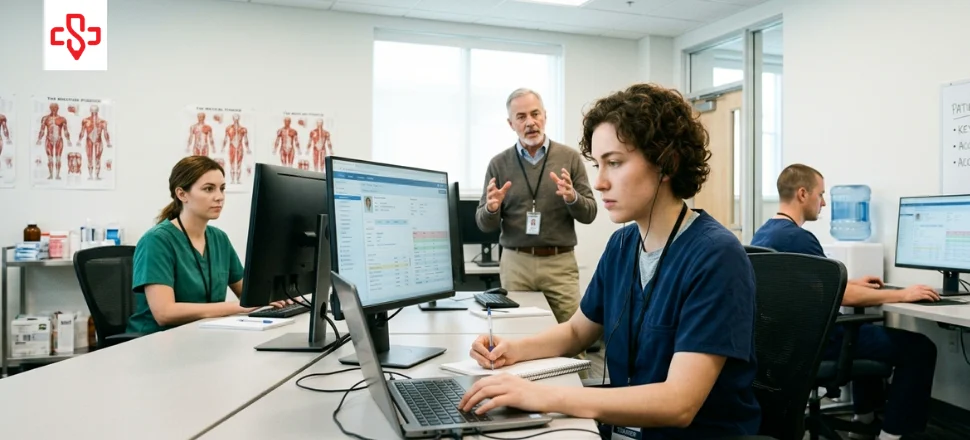

Liver disease presents some of the most layered documentation challenges in medicine. Hepatology scribes step into this complexity daily, translating dense clinical detail into accurate, structured notes. Because liver conditions often involve multiple overlapping systems, documentation must be thorough, precise, and quick to produce. As a result, hepatologists increasingly rely on trained scribes to keep pace with visit demands.
Why Liver Disease Documentation Demands Specialized Support
Chronic liver disease rarely presents in isolation. Consequently, hepatology visits often touch on nutrition, cardiology, nephrology, and psychiatry simultaneously. A single encounter might cover ascites management, encephalopathy screening, and medication reconciliation all at once. Therefore, documentation must reflect this interconnected picture without losing clarity. Hepatology scribes are trained specifically to capture these overlapping threads in real time.
Additionally, liver disease progresses through defined stages, each requiring distinct language and coding. Scribes familiar with hepatology terminology reduce the risk of vague or incomplete entries. This specialized knowledge also supports faster chart turnaround, which matters greatly in high-volume clinics.
Core Responsibilities of Hepatology Scribes
Hepatology medical scribes typically manage several recurring documentation tasks. These include recording lab trends, tracking imaging results, and noting medication adjustments tied to liver function. Since many patients are on complex regimens, scribes must document dosing changes with precision. Similarly, they capture symptom progression across visits, which helps providers identify subtle shifts in disease severity.
Scribes also support risk adjustment documentation for hepatology patients, since accurate chronic condition coding directly affects reimbursement and care planning. Because liver disease often carries multiple comorbidities, this coding accuracy becomes especially important.
Documenting Cirrhosis Staging and MELD Scoring
Cirrhosis staging requires exact, consistent documentation. Scribes record Child-Pugh classifications and MELD score components accurately, since these figures directly influence transplant eligibility and treatment urgency. A missed lab value or outdated score can delay critical decisions. Hepatology scribes therefore cross-check lab data against prior visit notes before finalizing documentation.
According to the American Association for the Study of Liver Diseases, standardized staging tools remain central to determining transplant priority and monitoring disease trajectory. Scribes trained on these frameworks help providers apply them consistently across every encounter.
Supporting Transplant Evaluation Workflows
Transplant evaluation visits generate an unusually high volume of documentation. Psychosocial assessments, imaging summaries, and multidisciplinary team notes all require careful recording. Hepatology medical scribes coordinate this information into a single coherent narrative, which supports smoother handoffs between hepatologists, surgeons, and social workers.
This coordination mirrors workflows seen in other high-acuity settings, such as those managed by inpatient scribes handling hospital-based liver patients. In both cases, documentation accuracy directly supports timely, well-informed clinical decisions.
Comparing General Scribes to Hepatology-Trained Scribes
The table below highlights key differences in documentation approach between general medical scribes and those trained specifically in hepatology.
| Documentation Area | General Medical Scribe | Hepatology Scribe |
|---|---|---|
| Disease Staging Terminology | Basic familiarity | Advanced, staging-specific vocabulary |
| Lab Trend Tracking | General lab entries | Liver panel-specific trend analysis |
| Transplant Workflow Support | Limited exposure | Trained in multidisciplinary documentation |
| Medication Complexity | Standard reconciliation | Liver-specific dosing awareness |
| Coding Accuracy for Comorbidities | General coding knowledge | Chronic liver disease coding specialization |
Training and Clinical Vocabulary for Hepatology Scribes
Effective scribes complete focused training before entering the clinic. This training covers liver anatomy, common diagnostic tests, and standard treatment pathways. Additionally, scribes learn abbreviations and shorthand unique to hepatology, which speeds up real-time documentation without sacrificing accuracy.</p
Ongoing education also matters, since treatment guidelines evolve regularly. Scribes who stay current, much like those supporting immunology scribes or ophthalmology scribes in their respective specialties, provide more reliable long-term documentation support.
The Impact on Provider Efficiency and Patient Care
When hepatology medical scribes manage documentation well, providers gain more direct time with patients. This shift often improves diagnostic conversations, since physicians are not distracted by note-taking. Meanwhile, patients benefit from more attentive, focused visits.
Efficient documentation also supports better continuity of care. Because liver disease requires long-term monitoring, consistent and detailed notes help every provider involved stay aligned. This is particularly valuable in settings offering live scribes in specialty medicine, where real-time accuracy directly shapes same-day treatment decisions.
Additionally, practices exploring remote support options often turn to virtual medical scribes as a flexible alternative to in-person staffing, particularly for smaller hepatology practices managing variable patient volumes.
Final Thoughts
Liver disease documentation carries real clinical weight, and small inaccuracies can affect treatment timelines. Hepatology scribes bring the specialized training needed to manage this complexity accurately and efficiently. Scribe.ology provides hepatology practices with scribes trained specifically for these demands, helping providers document with confidence while focusing more fully on patient care.