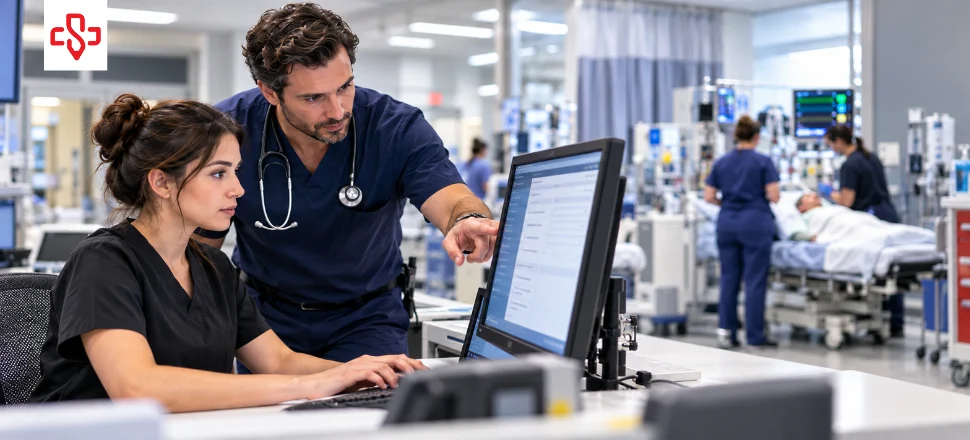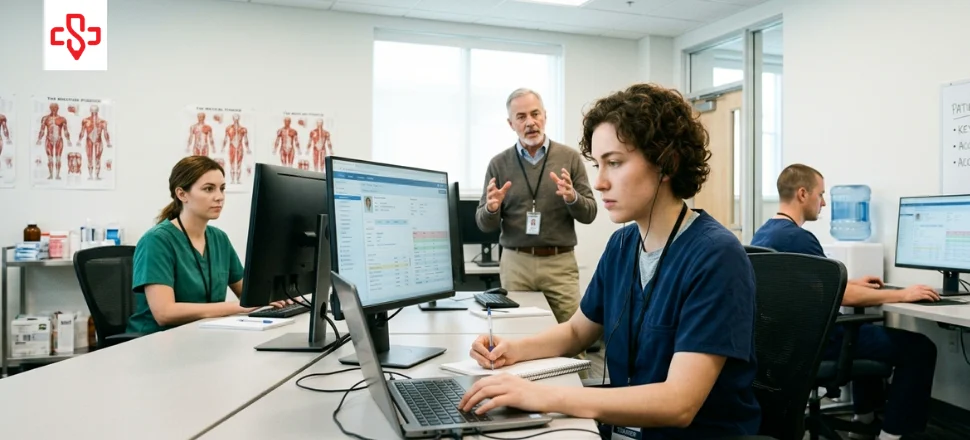
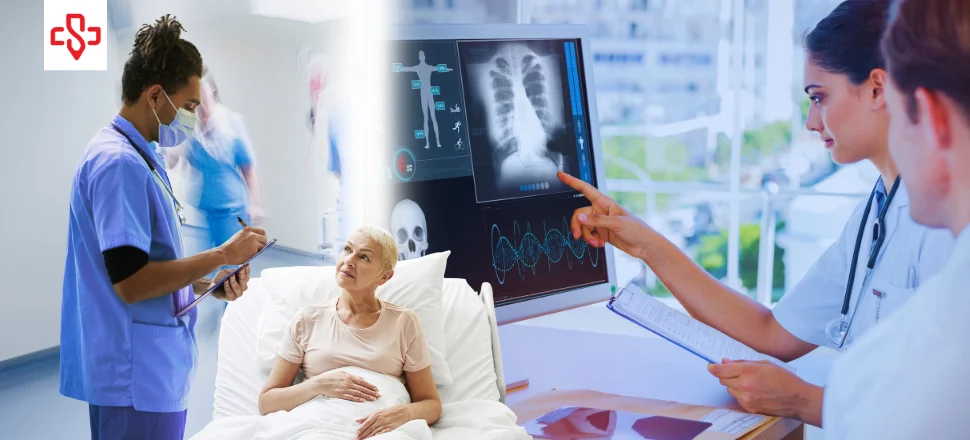
Emergency departments don’t pause for paperwork. In fact, a shift can turn critical in under a minute—trauma alerts, overlapping consults, a waiting room that doubles before the attending finishes a single note. As a result, documentation can’t wait. That’s exactly the problem live ER medical scribes are trained to solve.
Unlike remote transcription services or AI-generated summaries, live ER medical scribes work inside the department—tracking every order, timestamp, and clinical decision as it happens, not after the fact.
Why Standard Documentation Models Break Down in the ED
Most documentation tools are built for predictable workflows: scheduled appointments, single-provider encounters, and linear note structures. However, the emergency department invalidates every one of those assumptions.
For example, ED physicians routinely manage five to ten active patients at once, each at a different stage of diagnosis and treatment. Conditions escalate without warning, orders overlap, and handoffs happen mid-assessment. As a result, documentation lag isn’t just inconvenient—it creates clinical and compliance liability.
Emergency department scribes are built specifically for this environment, not adapted from outpatient models. In contrast to outpatient solutions, the workflow, training, and deployment structure are designed around ED volume, velocity, and unpredictability from the start.
What Live ER Medical Scribes Do That Automated Tools Cannot
Remote and AI-based tools run into predictable limits in emergency settings. For instance, audio lag causes sequencing errors, overlapping conversations create context gaps, and no algorithm interprets the urgency in a physician’s body language or knows that a routine chest pain workup just became a STEMI response.
By contrast, live ER medical scribes bring something automated tools fundamentally lack: situational awareness. When care escalates, the scribe anticipates the documentation sequence, tracks time-sensitive interventions, and captures every detail with precision. Consequently, both clinical outcomes and billing integrity are protected in real time.
Moreover, research published in the Western Journal of Emergency Medicine found that scribe use in emergency departments increases physician productivity by up to 15.9% and reduces patient length of stay by approximately 19 minutes. In other words, the impact is measurable and directly tied to patient care.
Inside a High-Acuity Shift
Consider a provider moving between a pediatric fever, a suspected stroke, and a fall with a possible hip fracture—all within thirty minutes. Each encounter carries distinct documentation requirements, order sets, and timing thresholds.
Meanwhile, a live scribe tracks all three simultaneously, keeping charts current across every active patient. When the stroke patient triggers a rapid neuro consult, the scribe captures the timeline down to the minute—because that timestamp affects treatment eligibility and legal exposure. As a result, no encounter falls behind because another one escalated.
The Cognitive Load Argument
Emergency physicians carry one of the highest cognitive loads in medicine. Specifically, diagnostics, procedures, team coordination, and real-time decision-making all compete for attention at once. When documentation gets added to that stack, something suffers—usually note completeness, provider wellbeing, or both.
Therefore, live ER medical scribes function as cognitive partners, not just note-takers. The physician stays focused entirely on the patient while the scribe owns the chart. That division of labor consequently allows providers to practice at the full scope of their clinical ability without administrative drag.
Furthermore, the same principle holds across care settings. Our post on EHR efficiency with scribes examines how this dynamic plays out in high-volume documentation environments more broadly.
Burnout Reduction Starts With Documentation Relief
Emergency physicians report some of the highest burnout rates in medicine. The clinical intensity is inherent to the work—however, after-shift charting is a separate, solvable problem.
Specifically, live ER medical scribes close notes in real time, before the provider leaves the department. That recovery of personal time produces measurable effects on satisfaction, retention, and sustainable practice. In addition, for administrators facing recruitment pressure, scribe programs offer a concrete intervention rather than a philosophical commitment.
Additionally, for ED groups that operate across multiple sites, consistent documentation quality is a related challenge. Our post on multi-hospital scribe programs addresses how uniform chart standards scale across rotating providers and varying EHR configurations.
Documentation Accuracy Under Pressure
Accuracy degrades under stress. In a crowded, noisy ED, even experienced clinicians miss documentation details—timestamps get approximated, medication dosages are rounded, and clinical reasoning gets compressed. Consequently, those gaps create downstream problems: billing denials, compliance flags, and audit exposure.
Fortunately, live ER medical scribes provide a stabilizing layer of precision. A scribe maintains accurate timestamps for every intervention, attributes orders to the correct provider, and ensures the documented clinical reasoning matches what actually occurred. That specificity matters when a payer or legal team reviews a chart months later.
In addition, this level of accuracy supports the broader care team. Hospital scribe services apply the same documentation discipline to inpatient settings, where handoff accuracy and nursing coordination carry equal weight.
Flexible Coverage Across the ED and Beyond
Live ER medical scribes aren’t one-size-fits-all. For example, high-volume trauma centers have different needs than rural EDs or community hospitals managing overnight volume with limited staffing. Coverage models should therefore flex to department volume, shift structure, and provider caseload.
Beyond the emergency department, practices running outpatient clinics or telehealth programs can similarly benefit from the same documentation-first approach. Outpatient scribe support extends the model into scheduled care environments, reducing note backlogs and improving chart completion rates. Likewise, for practices with a hybrid care model, virtual medical scribes provide remote documentation support with the same real-time standards.
The Case for Live Documentation in the ED
The instinct to automate documentation is understandable. However, the emergency department consistently exposes the limits of that approach. Complexity, simultaneity, and unpredictability are core features of ED care—not edge cases that technology will eventually solve.
Importantly, live ER medical scribes don’t replace technology. Instead, they complement it, adding the human judgment, contextual awareness, and real-time adaptability that no software currently replicates in a high-acuity clinical environment.
When the next trauma rolls in and the shift pivots in three directions at once, a live scribe is already moving with the team—documenting the unexpected before it becomes a gap in the record.
Ready to Support Your ED Providers?
Scribe.ology’s live ER medical scribes train specifically for the pace, complexity, and documentation standards of emergency medicine. Request a consultation to find out how live scribe support can reduce after-shift charting, improve note accuracy, and give your providers back their focus.