
Medical scribes malpractice risk is a growing concern for physicians who worry that a rushed or incomplete chart could become their weakest point in court. A malpractice claim rarely hinges on whether good care happened. Instead, it hinges on whether the record proves it happened. Consequently, the quality of a note can matter as much as the quality of the visit itself.
Courts and plaintiff attorneys treat the medical record as the primary evidence of what occurred during a patient encounter. If a note is vague, delayed, or missing key details, a jury may reasonably question whether the standard of care was actually met. Because of this, reducing documentation errors is not just an administrative goal; it is a legal safeguard.
Why Documentation Gaps Create Legal Exposure
Physicians are trained to treat patients, not to write court-ready legal narratives. Nevertheless, that is effectively what a chart becomes if a claim is filed months or years later. Memory fades, but the record does not. Therefore, any gap, contradiction, or missing timestamp becomes an opening for opposing counsel to argue that care was inadequate.
Several specific documentation failures raise medical scribes malpractice risk in practice:
- Missing informed consent language or incomplete discussion notes
- Delayed entries written well after the encounter, which can appear self-serving
- Copy-forward errors that carry outdated information into a new visit
- Absent differential diagnoses, which can suggest a provider did not consider alternatives
- Illegible or fragmented notes that leave gaps in the clinical story
Additionally, the same issues that cause documentation risk during audits tend to overlap with the issues that surface during litigation discovery. A note weak enough to fail a payer audit is often weak enough to undermine a legal defense.
How Real-Time Scribe Documentation Reduces Risk
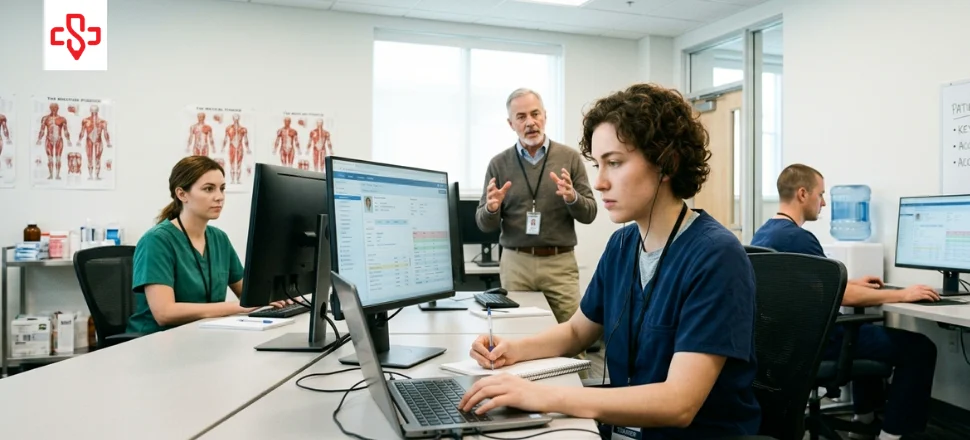
A trained medical scribe captures the encounter as it happens rather than reconstructing it from memory afterward. As a result, notes tend to be more complete, more consistent, and more clearly timestamped. This matters enormously in a legal context, since defense attorneys rely heavily on contemporaneous documentation to demonstrate that a provider met the standard of care.
Real-time charting also reduces the medical scribes malpractice risk tied to delayed or backdated entries. Because a scribe documents during the visit, the record reflects the actual sequence of clinical reasoning: symptoms reported, exam findings, differentials considered, and the plan explained to the patient. This sequence is often exactly what a plaintiff’s attorney tries to poke holes in during a deposition.
Furthermore, scribes are trained to consistently capture elements that providers frequently omit under time pressure, such as informed consent discussions and patient education. This is especially relevant in high-acuity settings, where ER documentation challenges can compound quickly during a busy shift.
The Connection Between Burnout, Rushed Notes, and Risk
Physician burnout is not just a wellness issue; it is a documentation risk multiplier. A fatigued provider working through a stack of unfinished charts is more likely to skip details, rely on templates without reviewing them, or write vague summaries late at night. Each of these habits increases exposure if a claim is ever filed.
Scribes directly address this by removing the charting burden from the provider’s plate. Research on scribe programs has shown that scribes can meaningfully decrease the documentation time for providers and allow them to spend more quality time with patients, which supports both better care and stronger records. When physicians are not racing to finish notes between patients, the resulting documentation is naturally more thorough. This is one reason the value of scribing services extends well beyond time savings alone.
Documentation Without a Scribe vs. With a Scribe
| Risk Factor | Without a Scribe | With a Trained Scribe |
|---|---|---|
| Timing of entries | Often written hours later, from memory | Captured in real time during the visit |
| Consent documentation | Frequently abbreviated or missing | Consistently recorded per protocol |
| Differential diagnosis detail | Sparse under time pressure | Fully captured as discussed aloud |
| Record consistency across visits | Prone to copy-forward errors | Reviewed and updated each encounter |
| Provider fatigue impact | High, especially late in shifts | Reduced, since charting load shifts to scribe |
Why This Matters Beyond the Courtroom
Strong documentation protects more than a physician’s legal standing. It also supports smoother audits, cleaner billing, and better continuity of care between providers. Because of this overlap, practices that invest in scribe support often see improvements across several risk categories at once, not just malpractice exposure. This mirrors findings from broader research on scribe programs, including their effect on ER scribe ROI and overall department performance.
Ultimately, medical scribes malpractice risk reduction comes down to one simple principle: a complete, contemporaneous record is the strongest defense a provider can have. When documentation accurately reflects the reasoning and care that took place, it becomes far harder for a plaintiff to argue otherwise. This is also why documentation quality is closely tied to doctor productivity benefits across a practice.
Reducing Malpractice Risk Starts With Better Documentation Habits
Physicians cannot eliminate the possibility of a malpractice claim. However, they can control how well-defended they are if one arises. Real-time, detailed, and consistent documentation is one of the most effective tools available, and it is exactly what a trained scribe is designed to support. Practices that treat documentation as a legal safeguard, not just an administrative task, put their providers in a far stronger position.
Scribe.ology provides trained medical scribes who help physicians reduce documentation gaps, support stronger legal protection, and reclaim time for patient care. Contact Scribe.ology today to learn how a dedicated scribe program can strengthen your practice’s documentation and reduce risk.