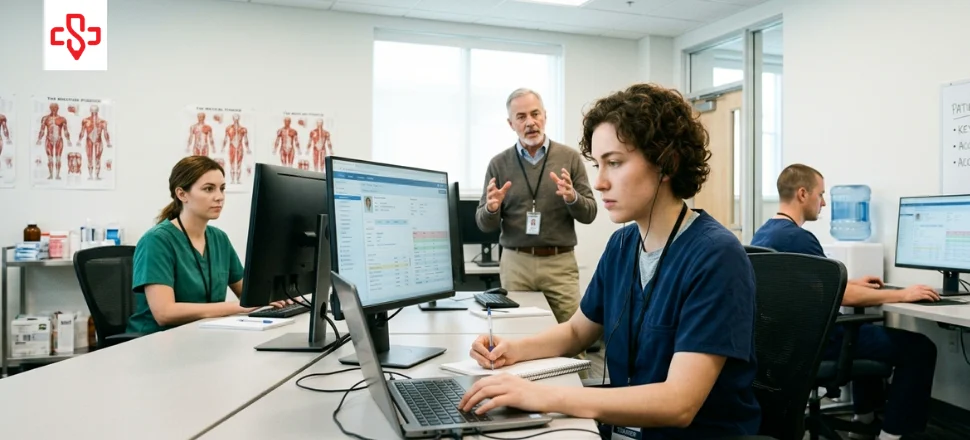
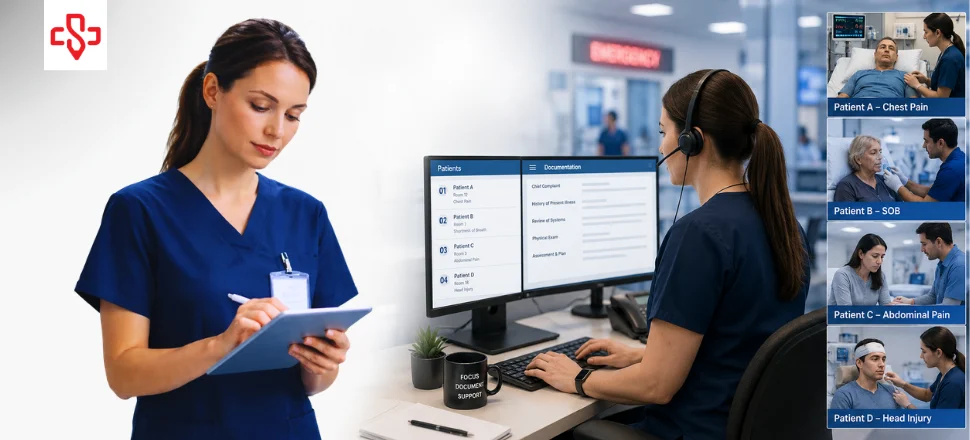
Walk into any emergency department on a Friday night. You’ll see the same scene repeated. For instance, a physician moves between a chest pain workup, a pediatric fever, and a laceration repair, often within the same ten minutes. Each patient sits at a different point in the diagnostic journey. Yet every chart still needs to be accurate, timestamped, and ready for sign-off. This is the reality of multi-patient documentation. In fact, it’s one of the hardest operational challenges in emergency medicine. Because of this, trained emergency department scribes have built specific habits and systems to keep pace with the chaos.
Why Multi-Patient Documentation Is So Difficult
Outpatient clinics schedule one provider with one patient in a fixed block. However, the emergency department doesn’t work that way. Instead, it runs on parallel tracks. For example, a physician might order labs for one patient, then step away to assess a trauma case, and later return to discuss imaging results with a third. As a result, each interruption carries clinical detail that must land in the correct chart, at the correct time. Similarly, our earlier piece on emergency department workflow covers how this pressure builds across a full shift.
The Core Techniques Scribes Rely On
Handling several active charts at once isn’t one skill. Rather, it’s a combination of habits built through repetition in fast-paced settings. Therefore, the table below breaks down the core techniques trained scribes use, along with why each one matters when documentation can’t lag behind care.
| Technique | What It Involves | Why It Matters |
|---|---|---|
| Parallel charting | Updating multiple active records as new information arrives | Prevents any single chart from falling behind |
| Cue-based prioritization | Reading tone, urgency, and nurse interruptions | Keeps documentation aligned with clinical urgency |
| Structured templates | Using standardized formats for history and exam findings | Keeps notes consistent across several patients |
| Order anticipation | Preparing the chart before orders are spoken | Cuts the lag between an order and its documentation |
| Real-time timestamping | Logging events as they happen, not after the fact | Protects treatment windows and audit defensibility |
| Team cross-checking | Confirming details with nurses and physicians | Keeps the chart aligned with the full care team |
Using Visual and Verbal Cues to Prioritize
Physicians rarely narrate every decision out loud. Therefore, scribes learn to read the room. For instance, a change in tone signals priority, while a sudden stat order signals urgency. Likewise, a nurse interrupting with new vitals signals which chart needs attention first. Additionally, our piece on live ER medical scribes looks at why this judgment is hard to replicate with remote or automated tools.
Structured Templates That Reduce Cognitive Load
Good multi-patient documentation isn’t just about speed. Instead, it’s about structure. Specifically, scribes rely on standardized templates for history, review of systems, and physical exam findings. As a result, these templates act as a scaffold, so when a scribe jumps from one chart to another mid-thought, they don’t lose their place. Moreover, this consistency also supports coding accuracy, a topic covered in our broader scribing services overview.
Anticipating Orders Before They’re Spoken
Experienced ER scribes, in turn, anticipate what comes next. For example, a physician orders a chest X-ray for suspected pneumonia. Consequently, a seasoned scribe already expects the follow-up discussion and prepares the chart. Because of this habit, the lag between an order and its documentation shrinks considerably. That gap matters most during multi-patient stretches, especially when there’s no time to reconstruct a timeline later.
Maintaining Accurate Timestamps Across Patients
Timestamps carry real clinical and legal weight. This is especially true for time-sensitive conditions like stroke or sepsis. After all, a physician managing multiple patients can easily lose track of exact timing. To prevent this, scribes log events the moment they happen rather than reconstructing them later. As a result, this protects treatment eligibility windows. Furthermore, it protects the hospital’s defensibility during an audit or claim review.
Why This Skill Set Is Hard to Automate
AI transcription tools keep improving. Nevertheless, they still struggle with one core challenge: knowing which conversation belongs to which chart in real time. For example, a peer-reviewed analysis in Annals of Emergency Medicine found measurable gains in throughput and revenue tied to scribe programs. Therefore, this skill is worth investing in, rather than outsourcing to software alone.
Building a Scribe Program That Supports This Workload
Not every documentation partner handles this level of complexity well. Consequently, hospitals should look for training that targets high-volume, multi-patient environments directly. For departments needing coverage outside standard hours, exploring scribe solutions is also worthwhile, since these extend the same real-time discipline into off-hours and hybrid care models.
Final Thoughts
Ultimately, multi-patient documentation tests whether a scribe program truly fits the emergency department. After all, it demands prioritization, structured habits, and real-time communication. In other words, fast typing alone won’t cut it. Therefore, hospitals that get this right see fewer documentation gaps and stronger compliance. As a result, their physicians move from patient to patient without carrying a backlog of unfinished charts. In short, Scribe.ology trains scribes specifically for this kind of high-volume, simultaneous documentation, so every chart stays current no matter how many patients are active at once.