
Emergency physicians chart in short bursts between constant interruptions. As a result, documentation often slips to the end of the shift. A clear emergency medicine scribe workflow changes that pattern by capturing the note while the physician cares for the patient. This guide covers each step, the note types, and a checklist you can use to evaluate scribe support.
Why the Emergency Department Needs Scribe Support
The emergency department (ED) moves fast. Physicians juggle multiple patients, frequent handoffs, and constant alerts. Meanwhile, the chart still has to be complete, accurate, and defensible.
Evidence supports the model. A multicentre randomised trial across five Australian EDs found that scribes raised physician productivity by 15.9% and shortened patient stays. You can read the full study in this PubMed Central trial. In addition, the researchers found no significant patient safety problems linked to scribe use.
Therefore, the question for most EDs is not whether scribes help. Instead, the question is how to set them up well. Strong virtual medical scribes can serve a busy department without adding badge, space, or training burdens on site.
The Emergency Medicine Scribe Workflow, Step by Step
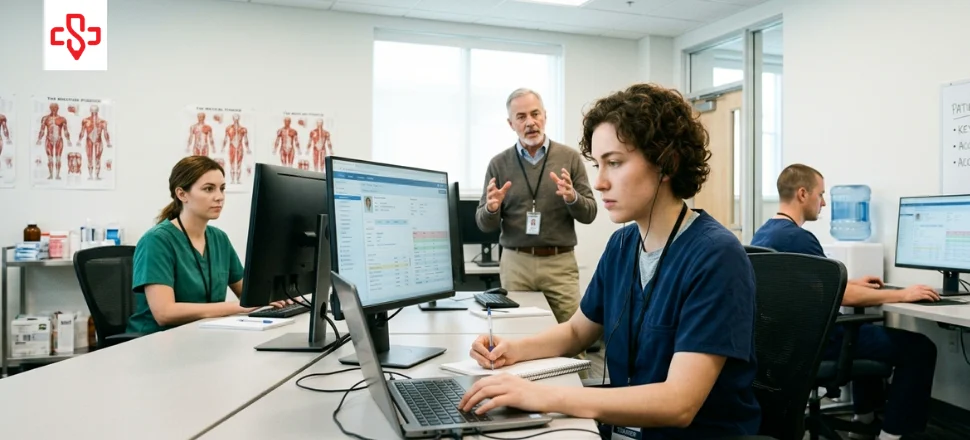
A well-defined emergency medicine scribe workflow keeps the scribe useful and the physician in control. First, the scribe joins the shift and reviews the tracking board. Next, the scribe opens the chart for each assigned patient and pulls in the triage details.
Then the physician enters the room, and the scribe listens in. The scribe records the history, exam findings, and the physician’s thinking as the encounter unfolds. This approach keeps details fresh and cuts down on after-shift charting. Dedicated emergency department scribe services build the whole shift around that rhythm.
After the encounter, the scribe drafts the note in the electronic health record (EHR). Meanwhile, the physician orders tests, reviews results, and decides on disposition. The scribe adds each result and reassessment as the physician shares it.
Finally, the physician reviews every note, edits it, and signs it. The scribe never makes clinical decisions. Likewise, the physician owns the final record.
Where Handoffs Fit
Shift changes create risk in any ED. For that reason, a scribe can help by keeping the running note current. As a result, the incoming physician sees the full ED course instead of piecing it together from memory.
Core Note Types in an Emergency Medicine Scribe Workflow
Scribes in the ED handle several note types. Each one follows the physician’s lead and your department’s templates.
- Initial physician note: history of present illness, review of systems, past history, and physical exam.
- Medical decision making (MDM): the differential, data reviewed, and the reasoning behind the plan.
- ED course and reassessment notes: changes in condition, responses to treatment, and repeat exams.
- Procedure notes: laceration repairs, splinting, intubation, and similar procedures, drafted from the physician’s dictation.
- Critical care documentation: the scribe captures details, but the physician must attest to critical care time personally.
- Consult and handoff notes: who was called, what they advised, and what the next team needs to know.
- Discharge and disposition notes: instructions, follow-up plans, and return precautions.
Accurate notes also support coding and billing. Therefore, complete ED documentation helps you reduce revenue leakage from missed acuity.
Common Challenges and How to Prevent Them
Even a good program faces predictable problems. However, most of them have simple fixes.
First, copy-forward errors can creep into notes. To prevent this, require scribes to document only what they hear and see during each encounter. Second, templates can hide gaps in the story. Because of this, keep templates flexible and let the physician’s narrative lead.
Third, privacy rules apply in every room. For example, the scribe needs HIPAA training and role-based EHR access. Finally, physician buy-in matters most. When physicians understand the workflow, they use the scribe well and chart faster. Better tools also ease physician burnout support efforts, since less after-hours charting leaves more time for rest.
Emergency Medicine Scribe Workflow Evaluation Checklist
Use this checklist when you compare scribe programs or vendors. Each item points to a risk you can check before you sign anything.
- ED experience: Does the scribe team know emergency terminology, pace, and note structure?
- Training: How long is training, and does it cover EHR navigation, medical terminology, and compliance?
- EHR fit: Can scribes work in your EHR with limited, role-based access?
- Quality review: Does the program audit notes for accuracy and completeness on a regular schedule?
- Scope of work: Are the boundaries clear on what a scribe may and may not do, such as entering orders?
- Privacy and security: Does the vendor follow HIPAA and sign a business associate agreement?
- Coverage: Can the team cover nights, weekends, and surge periods?
- Onboarding: How fast can a new scribe start, and what support follows?
- Metrics: Will you receive reports on charting time, throughput, and note quality?
- Turnover and backup: What happens when a scribe leaves or calls out?
Furthermore, ask for sample notes and references from other emergency departments. For the full process, follow our step-by-step guide to hire a medical scribe.
How to Measure Success
Set baseline numbers before you start. For instance, track time to chart completion, patients per hour, and door-to-doctor time. In addition, survey physicians on satisfaction after the first 60 to 90 days.
Then compare results against your baseline. If notes improve but throughput does not, review the workflow. Conversely, if throughput rises but note quality drops, tighten the audit process. Quality also depends on medical scribe training, so review how new scribes learn the ED workflow.
Final Thoughts on Your Scribe Workflow
An emergency medicine scribe workflow works best when each step is clear, the note types are defined, and quality is measured. Start with the checklist, test the fit, and track the results. Above all, keep the physician in control of the final note.
Ready to explore ED scribe support? Talk with the team at Scribe.ology about a program built around your department’s workflow.