
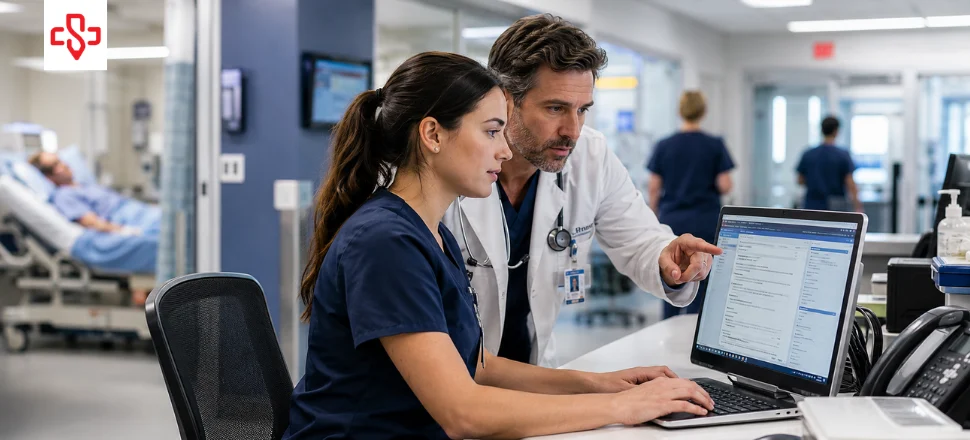
Hospitalist shifts rarely end when the last patient is seen. For many physicians, the workday stretches on well after rounds are complete. Chart notes, discharge summaries, and open orders still need attention. Physicians call this lingering documentation “pajama time.” It’s one of the most persistent sources of physician burnout in hospital medicine. Scribes for hospitalist charting offer a practical fix. A scribe captures the encounter as it happens, so the chart is ready to sign before the shift ends, not hours after.
Why Hospitalist Charting Runs Late
Hospitalists work a different rhythm than outpatient physicians. A single day might include new admissions, multiple rounding stops, family conversations, and coordination with specialists. Each of these generates its own documentation requirement. These encounters happen in quick succession, so notes wait for a quiet moment. That moment often doesn’t arrive until after hours. The chart backlog grows across the shift instead of shrinking.
Electronic health records add friction. Structured fields, dropdown menus, and click-heavy templates slow physicians down. A straightforward note can take longer to enter than it does to think through. Our virtual medical scribes page covers how a dedicated scribe absorbs this click burden. In short, the tools meant to streamline records often do the opposite for physicians working at a fast pace.
Real-Time Documentation Closes the Gap
A scribe embedded in rounds changes the sequence entirely. The physician no longer has to recall the details of an encounter later. Instead, the scribe documents findings, orders, and plans as the conversation unfolds. By the time the physician reaches the next room, the note is nearly done and simply waiting for review. Our live scribes post describes this same mechanism in outpatient settings. Here, it just applies to a rounding schedule instead of a clinic schedule.
The effect compounds across a full patient list. A hospitalist rounding on fifteen or twenty patients generates fifteen or twenty notes. If each note finishes at the bedside, no backlog remains to clear before signing off. Programs building this kind of coverage often start with the same staffing questions our scribe hiring checklist covers.
What This Means for End-of-Shift Handoffs
Timely documentation isn’t just about physician convenience. It directly affects patient safety at shift change. When charts stay current, the incoming hospitalist gets an accurate picture of overnight events, med changes, and pending results. Delayed notes create blind spots exactly when a handoff needs the most clarity. A scribe-supported workflow keeps the record synchronized with what actually happened during the day. This same principle drives the burnout documentation support our teams provide beyond just chart speed.
Complete same-day documentation also helps downstream teams that depend on the chart. Coders and CDI specialists can query and code more accurately from a finished note than from a placeholder entry someone fills in days later. This speeds up how cleanly a case moves through revenue leakage prevention, without documentation delays holding up the coding queue.
The Physician Wellbeing /services/revenue-leakageAngle
Beyond the operational case, there’s a human one. Hospitalists who leave work with closed charts report lower end-of-shift fatigue and less resentment toward the EHR. A time-study of internal medicine residents paired with scribes on inpatient teams found something telling. Residents consistently ranked documentation as the least meaningful part of the workday1. That finding reinforces why offloading it matters for how physicians experience a shift, not just how long the shift runs. Hospital medicine already carries high burnout rates. Finishing the workday without a stack of unsigned notes waiting at home is a real quality-of-life shift, not just an efficiency metric.
Getting Started with a Hospitalist Scribe Program
Programs that see the strongest results usually start small. A short pilot on one or two hospitalist teams works well. Track chart completion times before and after, then expand once the workflow proves itself. Matching scribe staffing to peak admission and rounding hours produces faster results than spreading coverage evenly across the day.
Hospitalist teams don’t need to overhaul their EHR or rounding process to see results. Scribe.ology places trained scribes directly into hospitalist workflows. Physicians finish their charts before they leave, not after they get home.