
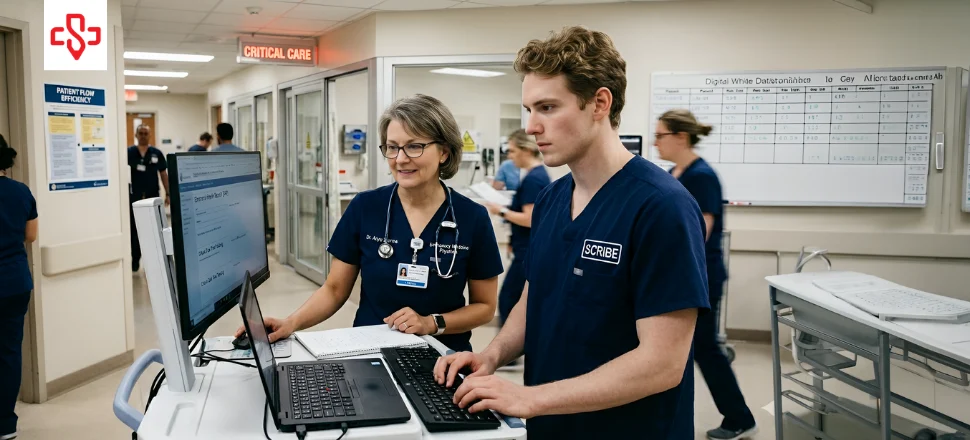
Emergency departments operate under constant pressure, balancing high patient volumes, urgent care needs, and extensive documentation requirements. In this fast-paced environment, maximizing productivity without compromising care quality is essential. One of the most effective ways to achieve this is through medical scribe support. Increasingly, healthcare organizations recognize how Scribes Increase ED RVUs by improving efficiency, documentation accuracy, and overall workflow.
Relative Value Units (RVUs) measure physician productivity based on the value of services provided. Therefore, improving RVUs per hour with medical scribing services directly impacts both operational performance and revenue generation in emergency departments.
Understanding RVUs in the Emergency Department
RVUs are a key performance metric in healthcare. They reflect the complexity, time, and resources required for patient care services. In emergency departments, physicians must manage multiple patients simultaneously while documenting each encounter accurately.
However, documentation demands often limit the number of patients physicians can see per hour. As a result, incomplete or delayed documentation can lead to lower RVU capture and missed revenue opportunities.
Documentation Burden and Its Impact on RVUs
Documentation is one of the most time-consuming aspects of emergency care. Studies show that physicians spend nearly 1.5 to 2 hours on documentation for every hour of patient care. Consequently, this reduces the time available for seeing additional patients.
Moreover, delayed documentation increases the risk of missing critical details, which can affect coding accuracy and RVU generation. Therefore, reducing documentation burden is essential for improving productivity.
How Scribes Increase ED RVUs
Scribes Increase ED RVUs by allowing physicians to focus on patient care while documentation is handled in real time. This shift significantly improves both efficiency and accuracy.
1. Real-Time Documentation
Medical scribes document patient encounters as they happen, ensuring that all clinical details are captured accurately. As a result, physicians no longer need to spend additional time completing notes after each visit.
This real-time approach reduces delays and ensures that documentation supports accurate coding, which directly contributes to higher RVU capture.
2. Increased Patient Throughput
When documentation is managed by scribes, physicians can see more patients per hour. In fact, research shows that medical scribes can improve physician productivity by 20–30%. Consequently, increased patient volume leads to higher RVU generation.
3. Improved Coding Accuracy
Accurate documentation is essential for proper coding. Scribes ensure that all relevant details—such as procedures, diagnoses, and medical decision-making—are recorded clearly.
Therefore, this improves coding accuracy and helps capture the full value of services provided, increasing RVUs per encounter.
4. Reduced After-Hours Charting
Physicians often spend hours completing charts after their shifts. However, with scribe support, most documentation is completed during the encounter.
As a result, physicians can focus more on patient care during their shifts, further improving productivity and RVU output.
Workflow Improvements with Scribe Support
The impact of scribes extends beyond documentation. By integrating into clinical workflows, they streamline processes and reduce inefficiencies. In emergency care support, where scribes enhance overall department performance.
Table: RVU Performance Without vs With Scribes
| Without Scribes | With Scribes |
|---|---|
| Limited patient throughput | Higher patient volume |
| Delayed documentation | Real-time charting |
| Lower coding accuracy | Improved coding precision |
| Frequent after-hours work | Minimal after-shift charting |
| Reduced RVU capture | Increased RVUs per hour |
Enhancing Patient Safety and Care Quality
While increasing RVUs is important, patient safety remains a top priority. Accurate documentation ensures that care decisions are based on complete and reliable information. know how scribes contribute to safer care in patient safety protocols, where documentation plays a critical role.
Financial Impact of Increased RVUs
Higher RVUs directly translate into increased revenue for healthcare organizations. By improving documentation accuracy and patient throughput, scribes help maximize billing opportunities.
Additionally, better documentation reduces claim denials and supports compliance, further strengthening financial performance.
Scalable Scribe Solutions for Emergency Departments
Emergency departments vary in size and patient volume, requiring flexible solutions. Fortunately, scribe programs can be tailored to meet specific needs, whether through on-site or virtual support.
Long-Term Benefits of Scribe Integration
The benefits of scribe support extend beyond immediate productivity gains. Over time, consistent documentation practices improve data quality, compliance, and operational efficiency.
Furthermore, reduced physician burnout leads to better retention and improved overall performance. Therefore, investing in scribes is a strategic decision for long-term success.
Conclusion
In the demanding environment of emergency medicine, maximizing productivity while maintaining care quality is essential. Scribes Increase ED RVUs by improving documentation accuracy, enhancing workflow efficiency, and enabling physicians to see more patients.
By reducing documentation burden and supporting real-time charting, scribes help emergency departments achieve better financial and clinical outcomes. Ultimately, they represent a powerful solution for healthcare organizations seeking to optimize performance.