
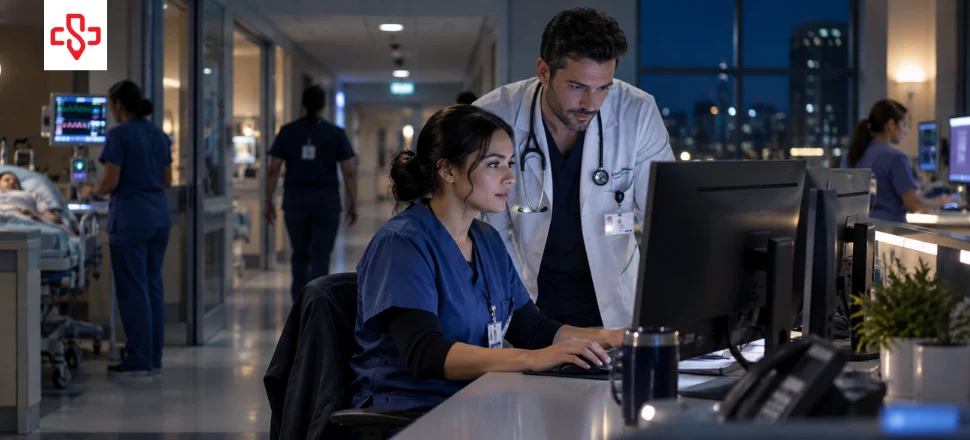
Most staffing conversations focus on daytime clinics. However, hospitals, urgent care centers, and emergency departments run around the clock. Documentation demands don’t pause at sundown. Overnight medical scribe coverage fills a gap that many staffing agencies quietly avoid. Night shifts are harder to recruit for, harder to retain, and easier to overlook in planning conversations.
This post looks at why overnight coverage matters and what makes it different from daytime staffing. It also covers how a dedicated scribe staffing model can keep documentation consistent, no matter what hour a patient walks through the door.
Why Overnight Hours Get Skipped
Night shift staffing is a known pain point across healthcare. Fewer candidates want overnight hours. So agencies often deprioritize those shifts in favor of easier daytime placements. As a result, overnight providers frequently chart alone. They end up squeezing documentation between patients or finishing notes well after their shift ends.
This isn’t a minor inconvenience. Overnight physicians and advanced practice providers already manage higher patient acuity in many settings, since after-hours visits often involve urgent or unpredictable cases. Adding unsupported documentation to that load increases the risk of burnout and delayed charting.
There’s also a practical staffing reality behind the gap. Recruiting for overnight roles generally takes longer and costs more per hire. So agencies working on volume-based placement models tend to fill daytime slots first, treating night coverage as an afterthought. Meanwhile, overnight providers often have the least bandwidth to advocate for better support, since they’re managing patient care with a smaller on-site team around them.
As one hospital medicine director put it during a staffing review: “When scribes disappear at night, physicians become their own scribes, and that’s not a sustainable trade for anyone.”
What Overnight Medical Scribe Coverage Actually Requires
Staffing the night shift isn’t simply a matter of extending daytime schedules. Building real overnight medical scribe coverage requires a different approach to scribe recruitment and training. The pool of candidates willing and able to work overnight is smaller, and the support structures around them need to look different too.
A few factors set overnight coverage apart:
- Shift consistency: Overnight scribes need predictable schedules so fatigue and turnover don’t undermine documentation quality.
- Specialty familiarity: Emergency medicine and hospitalist documentation move quickly, so scribes need training that matches fast-paced clinical settings rather than routine outpatient visits.
- Communication protocols: With fewer staff on-site overnight, scribes and providers need clear, quick ways to flag documentation questions without waiting for daytime supervisors.
- Reliable technology access: Whether scribes work on-site or remotely, overnight coverage depends on stable systems, since IT support is often thinner after hours.
Meeting these requirements consistently is what separates a true overnight staffing solution from a daytime team stretched too thin.
The Cost of Leaving Night Shifts Unsupported
When overnight documentation support is missing, the effects tend to show up gradually rather than all at once. Notes get finished late. Providers spend post-shift hours catching up rather than resting. Over time, this pattern feeds the kind of clinician burnout that shows up repeatedly in emergency and hospital medicine research.
Research on physician documentation burden has consistently linked after-hours charting, which many clinicians call “pajama time,” to fatigue and reduced job satisfaction, according to a peer-reviewed study on resident physician EHR use. Overnight shifts, where support is already thinnest, tend to concentrate this burden even further.
There’s also a quieter cost: documentation accuracy. A provider’s memory hours after a shift ends is simply less reliable than a note captured in real time. Overnight cases often involve decisions made quickly under pressure, and that gap matters for both continuity of care and compliance.
Turnover compounds all of this. When overnight providers repeatedly work without support, some eventually request a shift change or leave the organization altogether. That forces leadership back into recruiting for the very hours that were already hardest to staff. Breaking that cycle usually means addressing documentation support directly, rather than waiting for general staffing levels to improve on their own.
Building a Staffing Model That Covers All Hours
A workable overnight staffing plan usually combines a few elements rather than relying on one fix. Staggered shift structures help avoid single points of failure, so no scribe carries an entire overnight block alone. Cross-training scribes across day and night shifts also builds a more flexible bench, since staff familiar with both rhythms can step in when coverage gaps appear.
Remote scribe support is another piece worth considering. Much of overnight documentation work can happen through virtual scribe support. That widens the candidate pipeline considerably, since staffing pools no longer depend only on people willing to commute at 2 a.m.
Finally, retention strategies matter more overnight than anywhere else in the schedule. Night shift staff who feel like an afterthought in scheduling decisions tend to leave faster. That restarts the training cycle and reintroduces the same coverage gaps.
Onboarding also deserves a second look for overnight roles. A new scribe who starts directly on an overnight shift, without exposure to daytime pacing, can struggle to calibrate against the volume and urgency of after-hours cases. A short overlap period, where a new overnight scribe shadows a busier daytime or evening shift first, tends to shorten the ramp-up time and reduce early turnover.
What to Look for in an Overnight Coverage Partner
Not every staffing partner treats overnight hours as a priority. When evaluating options, ask directly how a vendor recruits, trains, and retains scribes specifically for night shifts. Don’t assume daytime processes will simply transfer over.
Questions worth raising include:
- How does the vendor track and address overnight scribe turnover?
- What backup coverage exists if a scheduled overnight scribe is unavailable?
- Does the vendor train overnight scribes specifically for emergency and hospitalist documentation pace?
- How quickly can the team resolve documentation questions without daytime supervisors on hand?
Clear answers to these questions usually indicate a partner that has actually built infrastructure for the overnight shift, rather than one applying a daytime model to hours it doesn’t fully understand.
Closing Thoughts
Overnight care doesn’t pause for staffing convenience, and documentation shouldn’t either. Reliable overnight medical scribe coverage protects both provider well-being and note accuracy during hours that teams too often treat as an afterthought.
Scribe.ology builds staffing models around the full 24-hour clinical day, including the overnight hours other providers tend to skip. If your organization wants to close overnight documentation gaps, reach out to the Scribeology team to talk through a coverage plan built for your shift patterns.