
Physicians enter medicine to heal people, not to type. Still, charting now fills a large part of every shift. Medical scribing solves this problem. In fact, scribes improve patient care by taking documentation off the provider’s plate, so attention returns to the person in the exam room.
This guide explains what medical scribing is, how it works, and why it matters to patients. Along the way, you will see where scribes make the biggest difference.
What Is Medical Scribing?
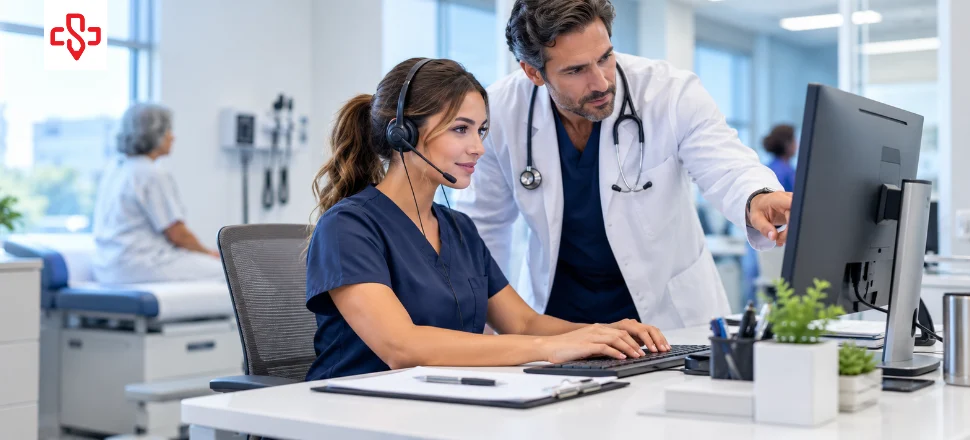
Medical scribing is the real-time documentation of a patient visit by a trained professional. The scribe works beside the provider and records the history, exam findings, and treatment plan in the electronic health record (EHR). Meanwhile, the provider focuses on diagnosis and conversation.
Scribes are often pre-health students or trained documentation specialists. Before joining a team, they learn medical terminology, EHR navigation, and privacy rules. Therefore, they understand clinical language and protect patient information from day one.
Just as important, a scribe never acts as a clinician. A scribe does not:
- Diagnose or treat patients
- Place orders without provider approval
- Sign or approve final notes
Instead, the scribe drafts the note, and the provider reviews, edits, and signs it. As a result, the provider keeps full control of the chart. For a closer look, see this guide to medical scribe duties.
How Medical Scribing Works Step by Step
Every practice sets its own workflow. However, most visits follow the same simple pattern:
- Before the visit: The scribe reviews the schedule and prepares the chart.
- During the visit: The scribe records the history, exam, and plan as the provider speaks.
- After the visit: The scribe finalizes the draft and lines up orders for review.
- Provider sign-off: The provider checks the note for accuracy and signs it.
Because each step happens during the shift, notes are ready before the next patient arrives. Consequently, nothing waits until evening.
Scribes can work in the room or join remotely through secure audio or video. Either way, the provider reviews every note before it enters the record.
How Scribes Improve Patient Care
Medical scribes improve patient care in several clear ways. Patients rarely see the charting, but they feel its effects in every visit. Most benefits come down to one thing: the provider’s attention.
Better listening and eye contact. Without a scribe, many providers split their focus between the patient and the screen. With a scribe, the provider can face the patient, listen fully, and explain next steps. In turn, patients tend to share more detail, which supports better diagnoses.
Shorter waits and smoother visits. Documentation slows every encounter. When a scribe handles it, visits run closer to schedule. Therefore, patients wait less, and providers can see more people without rushing.
More accurate, complete records. Notes written during the visit capture details that memory loses by evening. Specifically, scribes record symptoms, medications, and patient concerns while they are fresh. To learn more, read about scribe note accuracy.
Safer handoffs. Complete notes help the next clinician. When a chart tells the full story, covering providers spot key details quickly. As a result, handoffs run smoother, and the risk of missed information falls.
Stronger patient trust. Patients usually welcome a scribe once the provider explains the role. Many practices introduce the scribe at the start of the visit. Overall, this openness builds confidence, and you can explore patient trust in scribes in more detail.
| Visit Factor | Without a Scribe | With a Scribe |
|---|---|---|
| Provider attention | Split between patient and screen | Focused on the patient |
| Note completion | Often finished after hours | Ready during the shift |
| Visit flow | Delays build up | Schedule stays on track |
| Record detail | Details fade from memory | Details captured live |
Why Scribes Improve Patient Care: The Documentation Burden
The documentation burden is well documented. For example, a widely cited study in the Annals of Internal Medicine found that physicians spend nearly two hours on EHR tasks for every hour of direct patient care. Clearly, that imbalance pulls time away from patients.
Scribes narrow that gap. This simple shift benefits everyone in the room. When documentation happens during the visit, providers finish sooner and leave work on time. Over time, this protects provider well-being. In turn, patients enjoy steadier, more attentive care. Provider attention is a limited resource, and scribes improve patient care by protecting it.
Key takeaway: Scribes improve patient care because they return the provider’s time and attention to the patient.
Where Scribes Make the Biggest Difference
Scribes support nearly every care setting. However, three settings stand out:
- Emergency departments: The fast pace leaves little time to chart, so emergency department scribes keep records current.
- Outpatient clinics: Busy primary care and specialty practices use outpatient scribe services to protect visit time.
- Hospitals: Inpatient teams rely on scribes during rounds, admissions, and discharges, where notes move fast and accuracy matters.
In addition, virtual scribes support telehealth visits from a remote location. This option helps practices that lack space for an in-room scribe.
Is Medical Scribing Right for Your Practice?
Scribing fits practices with heavy documentation loads. Consider a scribe if you notice these signs:
- Providers finish charts after hours
- Notes arrive late or incomplete
- Patients mention long waits
- Provider burnout keeps rising
Start small. A pilot with one or two providers shows the real impact before you expand.
Before you start, define your goals, choose a clear workflow, and prepare providers to work with a scribe. When you are ready to build a team, this guide to hiring a medical scribe walks through each step.
Medical scribing is simple in concept and powerful in effect. Scribes handle the chart, providers handle the care, and patients feel the difference. Whether you run a clinic or a hospital unit, the goal stays the same: more time for patients. Ready to see how scribes improve patient care in your practice? Partner with Scribe.ology for trained, reliable documentation support. Then, request a free consultation today.