
Allergy and immunology practices carry one of the heaviest documentation burdens in outpatient medicine. A single visit may involve a detailed allergy history spanning years, multiple trigger exposures, a complete review of systems, immunotherapy dosing records, lab results, and an evolving management plan. For specialists seeing 20 or more patients each day, this volume of documentation creates a significant workload that is difficult to manage without support.
Immunology scribes help reduce that burden by documenting patient encounters in real time. As a result, the note is complete when the visit ends rather than hours later when details may be harder to recall.
For outpatient specialty practices, the combination of patient volume, clinical complexity, and documentation requirements can increase stress and burnout. Specialists who work with dedicated scribes often finish their clinical day without a backlog of charts. This improvement supports both physician well-being and long-term retention.
Why Immunology Documentation Is Unusually Complex
Allergy and immunology visits are rarely simple. Patients often present with multiple conditions at the same time. Asthma, allergic rhinitis, food allergies, eczema, and immune deficiencies frequently overlap. Documentation must accurately reflect every condition and its impact on care.
Treatment plans are also highly detailed and long-term. Notes from one visit often guide dosing decisions, referral timing, and safety protocols at future appointments.
Immunotherapy documentation adds another layer of complexity. Subcutaneous immunotherapy (SCIT) and sublingual immunotherapy (SLIT) require careful tracking of antigen concentrations, injection volumes, reaction monitoring, and dose-escalation schedules. A documentation error in an immunotherapy record is more than a coding issue—it can affect patient safety. Providers must enter these details accurately while the encounter is still in progress.
Without support, specialists often follow a familiar pattern. They chart between visits, fall behind, and spend additional hours completing notes after clinic hours. Note quality suffers when physicians rely on memory instead of documenting encounters in real time.
What Immunology Scribes Do During a Patient Visit
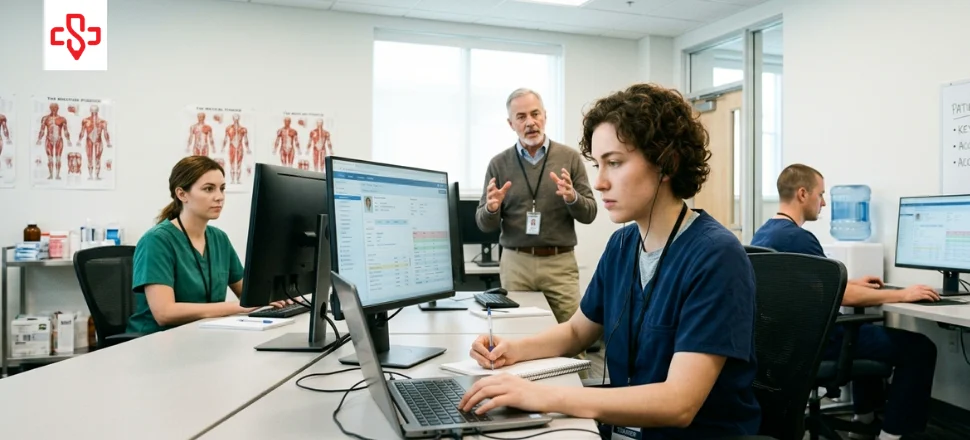
A trained immunology scribe works alongside the specialist throughout each encounter. The scribe enters information into the EHR as the visit unfolds. This process provides real-time documentation rather than post-visit transcription.
During a typical allergy or immunology visit, the scribe may document:
- Allergy and symptom history — including trigger exposures, reaction patterns, and symptom frequency as discussed during the patient interview
- Review of systems — recorded completely while the physician conducts the review
- Physical examination findings — entered as the provider performs the examination
- Skin testing and diagnostic results — documented accurately with the appropriate codes and clinical context
- Immunotherapy records — including dosing, concentrations, administration notes, and any observed reactions
- Assessment and plan — capturing clinical reasoning, medication changes, referral decisions, and follow-up instructions
After the encounter, the physician reviews the note and signs off. This process typically takes only a few minutes. Without a scribe, completing the same documentation would require significantly more time. Across 20 or more daily visits, the time savings can be substantial.
The Impact on Patient Flow and Physician Burnout
Documentation burden remains one of the leading causes of dissatisfaction among allergy and immunology specialists. The specialty combines high patient volume with highly detailed notes. As a result, many physicians spend additional hours completing charts after clinic.
Immunology scribes help change that dynamic. When documentation occurs in real time, patient throughput improves. Physicians no longer need to manage a growing charting backlog while seeing new patients. Visits flow more smoothly because providers can focus fully on the patient rather than splitting attention between the conversation and the EHR.
Patients often notice the difference. More direct interaction and attention can contribute to higher satisfaction scores.
Coding Accuracy and Revenue Integrity
Immunology billing includes evaluation and management codes, allergy testing codes, immunotherapy administration codes, and diagnosis codes for multiple coexisting conditions. When documentation is rushed or incomplete, coding accuracy often suffers. This can lead to undercoding and lost revenue.
Immunology scribes trained in specialty documentation understand which clinical details support accurate coding. They capture the complexity of medical decision-making, diagnosis specificity, and immunotherapy documentation requirements during the encounter itself.
As a result, practices benefit from cleaner claims, fewer denials, and more accurate reimbursement. For clinics that perform high volumes of allergy testing and immunotherapy administration, consistent documentation can have a measurable impact on monthly revenue.
Virtual Scribes for Immunology Practices
Not every immunology clinic has the space or workflow needed for an onsite scribe. Virtual scribes provide an effective alternative. They connect securely during patient encounters and document visits remotely in real time.
Virtual medical scribes work within the same EHR platforms used by immunology clinics, including Epic, Cerner, and Athena. They can also support multiple exam rooms or clinic locations simultaneously. For multi-provider practices, virtual coverage often scales more efficiently than onsite staffing while maintaining documentation quality.
Conclusion
Immunology practices face some of the most demanding documentation requirements in outpatient care. From complex allergy histories to detailed immunotherapy records, providers must capture a significant amount of clinical information during every visit. Immunology scribes help manage this workload by documenting encounters in real time, improving note accuracy, supporting coding integrity, and reducing after-hours charting. Whether working onsite or remotely, scribes allow specialists to focus more on patient care while maintaining complete and compliant documentation. For practices looking to improve efficiency and reduce physician burnout, immunology scribes offer a practical and scalable solution.