ED scribe vs ED tech is a common question for emergency department leaders. Both roles support busy clinicians. However, they solve very different problems. A scribe handles documentation, while a tech handles hands-on patient tasks. This guide explains how the two roles differ in duties, training, and scope. As a result, you can staff your department with confidence.
What Does an ED Scribe Do?
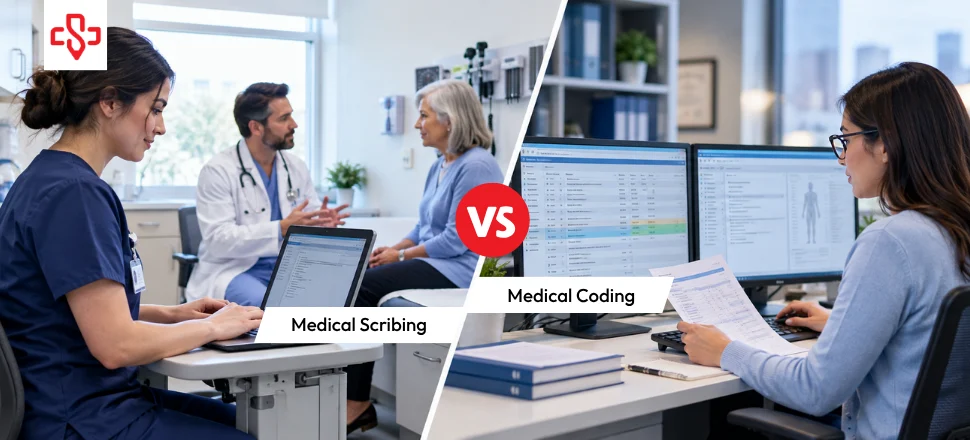
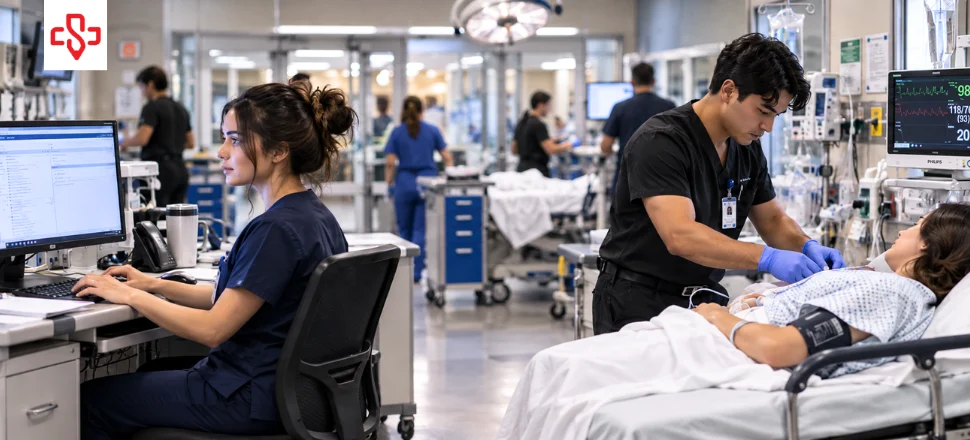
An ED scribe documents the patient encounter in real time. Specifically, the scribe records the history, exam findings, and orders in the electronic health record. The physician then reviews, edits, and signs the note. Because of this workflow, the physician spends less time typing and more time with patients.
A scribe does not provide clinical care. For example, a scribe never touches a patient, orders tests independently, or makes medical decisions. Instead, the scribe shadows one provider per shift. In addition, many scribes track lab and imaging results and prepare discharge paperwork. See the full emergency medicine scribe workflow for a step-by-step view.
What Does an ED Tech Do?
An ED tech is a hands-on clinical support role. Techs work under the direction of nurses and physicians. Typical tasks include taking vital signs, performing EKGs, drawing blood, and applying splints. They also help with wound care, patient transport, and restocking supplies. In addition, many techs perform CPR during codes and trauma activations.
Scope varies by state and by hospital. For instance, some facilities allow techs to place urinary catheters, while others do not. Therefore, always check local policy and state rules before you define the role. Your staffing plan should reflect those limits.
ED Scribe vs ED Tech: Key Differences in Duties
The simplest difference is this: scribes document care, and techs deliver care. For example, a scribe types the exam findings while the physician performs the exam. In contrast, a tech may obtain the EKG that the physician reads. Consequently, the two roles rarely overlap. Neither role replaces the other.
| Feature | ED Scribe | ED Tech |
|---|---|---|
| Primary focus | Documentation | Hands-on patient support |
| Patient contact | None; observes only | Direct, throughout the shift |
| Core tasks | Charting, result tracking, discharge paperwork | Vitals, EKGs, blood draws, splinting, transport |
| Works under | One physician or provider | Nurses and physicians |
| Main benefit | Less physician charting time | More hands-on care capacity |
Scribes mainly cut physician charting time. Techs mainly expand how much direct care your team can deliver. For a broader primer, see how medical scribing works.
ED Scribe vs ED Tech: Training and Qualifications
ED Scribe Training
Most scribe programs last from several days to a few weeks. Training covers medical terminology, EHR navigation, HIPAA basics, and ED workflow. In addition, new scribes typically shadow an experienced scribe before working solo. Many scribes are pre-med or pre-health students, so strong typing and listening skills matter. Optional certification programs exist, but requirements vary by employer. Strong medical scribe training keeps quality consistent.
ED Tech Training
Training for ED techs is more clinical. Many hospitals require current Basic Life Support (BLS) certification. Some also prefer an EMT-Basic or nursing assistant credential. Meanwhile, hospitals often teach skills such as phlebotomy and EKG acquisition on the job. As a result, tech onboarding can take longer than scribe onboarding. It usually includes competency check-offs as well.
Which Role Does Your Emergency Department Need?
Start by looking at your bottleneck. If physicians finish shifts late because of charting, a scribe is the better fit. In fact, research supports this. A multicentre randomised trial tested scribes in five Australian emergency departments. Physicians saw 15.9% more patients per hour with a scribe. In addition, patient length of stay fell by 19 minutes.
On the other hand, a tech is the better fit when nurses lack hands-on help with vitals, EKGs, and transport. In the ED scribe vs ED tech decision, the right answer depends on your workflow gap. If you choose a scribe, follow this guide to hire a medical scribe.
Many departments use both roles. The tech keeps patient care moving, and the scribe keeps the chart current. Together, they let physicians and nurses focus on the work only they can do. Either way, track results with scribe program KPIs.
Final Thoughts on ED Scribe vs ED Tech
In short, an ED scribe documents the visit, and an ED tech helps deliver care. Their duties, training, and scope differ, so each role solves a different staffing problem. Evaluate your workflow first, and then choose the role that closes your biggest gap. If documentation is that gap, explore emergency department scribe services.
Ready to cut charting time in your emergency department? Scribe.ology is a physician-founded company that provides trained medical scribes to healthcare teams. Contact Scribe.ology to build a scribe program that fits your team.